Best Dog Food for an Active Adult Cane Corso vs a Sedentary One
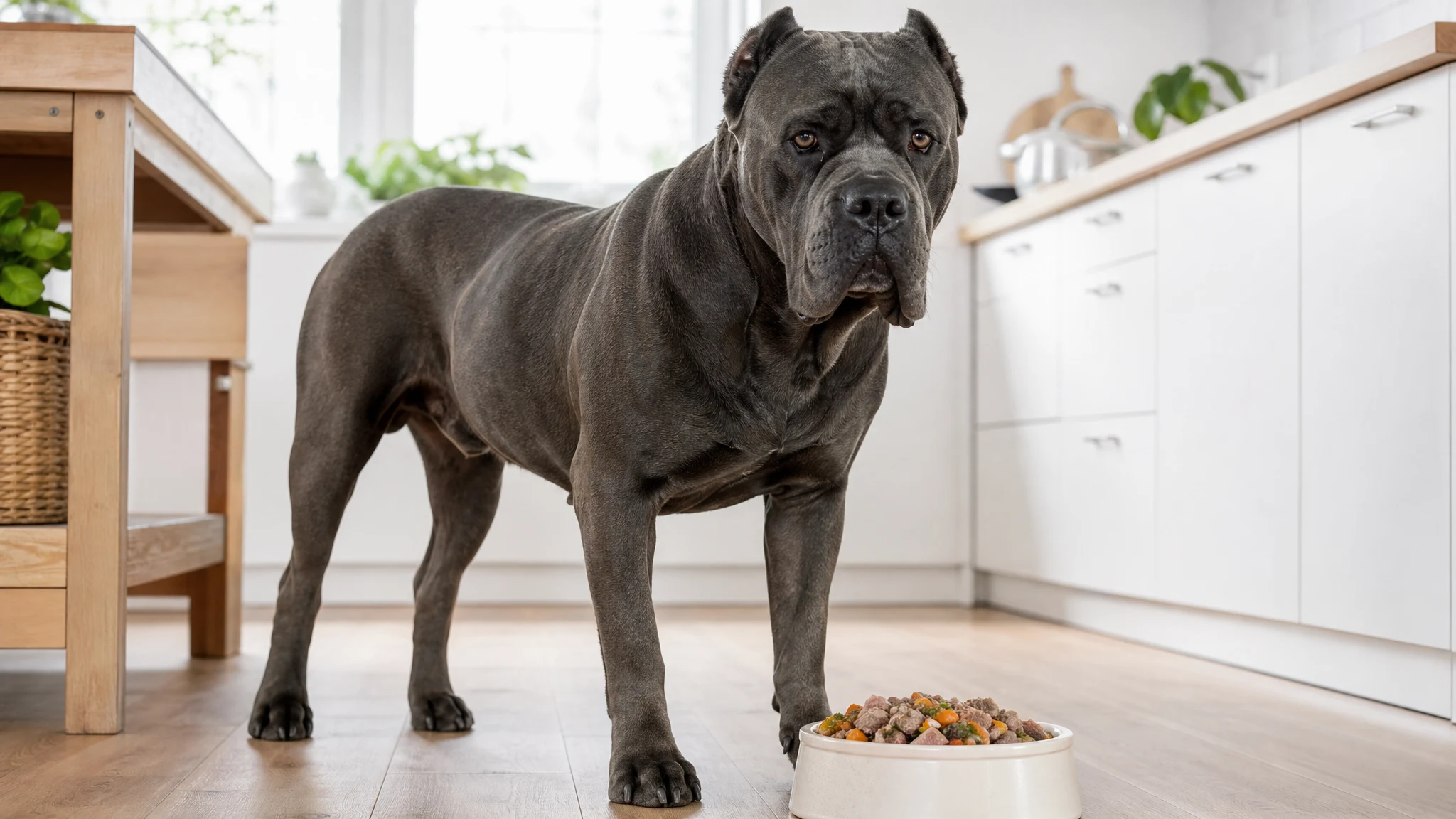
General nutrition information compiled from product labels and published sources, not veterinary advice. Your veterinarian is the right person to choose a diet for your dog, especially one with a health condition.
A working-line Cane Corso who hikes every day and a couch-loving Cane Corso of the same weight do not always need the same bowl. No single bag is the best food for both. The better question is which label fits your dog's body, energy use and veterinarian's advice.
This guide walks through that decision step by step. It compares label data only. We did not run feeding trials or taste tests, and nothing here says a food will prevent or treat any condition.
What you need before you start
- Your dog's current weight, ideally from a recent vet visit.
- The bag or can of the food you feed now, with the AAFCO statement and calorie content.
- A standard measuring cup or a kitchen scale.
- A notebook or phone note for weekly weight and body checks.
- Your veterinarian's contact details, since they make the final call for an individual dog.
Know the breed baseline first
The Chewy breed education page lists an adult Cane Corso at 88 to 110 pounds and a life expectancy of 9 to 12 years. That puts the breed above the 70 pound large-size mark that AAFCO uses on growth labels, so large-breed formulas are the natural place to look.
The same page flags obesity as a concern because extra weight strains the joints. It also names bloat (GDV) as a risk for deep-chested dogs. The Cane Corso Association of America lists hip dysplasia, elbow dysplasia and cardiac evaluation in its CHIC health testing program. Food does not prevent any of these. It does affect how easy it is to keep a lean body weight, which is the part you control.
For broader background, see our guide on the diet factors that matter for a Cane Corso.
Step 1: Confirm your dog is an adult
This guide covers adults. The breed sources we relied on do not give an exact age when a Cane Corso counts as an adult, so ask your veterinarian when to switch from a growth food.
Do not move a growing puppy to an adult food early. Whole Dog Journal notes that too much calcium can harm large-breed puppies and that growth foods should be labeled for large-size dogs. Likewise, a fresh adult-maintenance food is not a puppy food.
Step 2: Describe your dog's activity honestly
Use three plain categories:
- Active: long daily exercise, running, cart pulling, or regular sport or work.
- Moderate: daily walks and some play.
- Sedentary: short walks, lots of lounging, or reduced mobility.
Most pet Cane Corsos land in the middle. Be skeptical of any bag that calls itself "performance" or "weight care" without showing the calorie number behind the name.
Step 3: Check the AAFCO statement
Find the sentence near the ingredient list. For an adult you want "complete and balanced" for maintenance or for all life stages. Hill's Science Diet Adult Large Breed states that AAFCO feeding tests substantiate maintenance nutrition for adult dogs. Royal Canin Large Adult says it is formulated to meet AAFCO Dog Food Nutrient Profiles for maintenance. Victor Elite Canine is labeled for all life stages.
Statements can change with reformulation, so read the current wording on the brand's own page before you buy.
Step 4: Compare calories, protein, fat and first ingredients
Calories per cup matter most when you compare an active dog with a sedentary one. Protein and fat percentages come second. Note that Hill's publishes dry matter averages, while Royal Canin and Victor publish as-fed minimums, so those columns are not directly comparable.
| Food (dry unless noted) | Label focus | Calories | Protein / fat | First ingredients |
|---|---|---|---|---|
| Hill's Science Diet Adult Large Breed Chicken & Barley | Adult maintenance, ideal weight 55 to 110 lb | 365 kcal per cup | 23.8% / 15% (dry matter averages) | Chicken, cracked pearled barley, brown rice, brewers rice, whole grain wheat |
| Hill's Science Diet Adult 6+ Large Breed | Mature adult maintenance | 352 kcal per cup | 18.7% / 13.5% (dry matter averages) | Chicken meal, cracked pearled barley, brewers rice, whole grain wheat, whole grain corn |
| Royal Canin Size Health Nutrition Large Adult | Adult 15 months to 5 years, 56 to 100 lb | 360 kcal ME per cup | 24% min / 15% min | Chicken by-product meal, brewers rice, wheat, brown rice, chicken fat |
| Royal Canin Size Health Nutrition Large Aging 8+ | Senior large breed | 308 kcal ME per cup | 25% min / 15% min | Chicken by-product meal, brewers rice, wheat, corn gluten meal, chicken fat |
| Victor Elite Canine | All life stages, large breed, normal activity | 386 kcal per cup | 25% min / 14% min | Chicken meal, whole grain brown rice, grain sorghum, peas, chicken fat |
| Freshpet Complete Nutrition Chicken Recipe (fresh roll) | Adult maintenance, all-size | 1,357 kcal/kg, calculated (308 kcal per 1/2 lb) | 7.5% min / 7% min | Chicken, chicken broth, brown rice, rice bran, carrots |
The Hill's pages we used did not list guaranteed analysis minimums. Royal Canin, Victor and Freshpet publish them. The Freshpet figures look low because the roll is mostly moisture, so do not compare them to dry food by percentage alone. Kibble size is not published for most of these foods, so ask the brand if jaw size matters to you.
Step 5: Match the food to your dog's activity level
For an active adult
An active dog may do well on a higher-calorie adult formula, because you can feed less volume for the same energy. On label data, Victor Elite Canine has the highest calories per cup in the table above and is labeled for normal activity. Royal Canin Large Adult and Hill's Adult Large Breed sit a little lower. Any of them could suit an active dog if body condition stays lean, but only your dog's weight trend can say.
Do not assume more protein means more performance. A label with a high protein number is not automatically better for a dog who already eats a complete diet.
For a sedentary adult
A sedentary dog has less room for extra calories. A formula with fewer calories per cup lets you keep a satisfying portion without overshooting. Among the options above, the senior large-breed formulas have the lowest calories per cup. Those are written for older dogs, so ask your veterinarian before using one for a younger, inactive dog.
The fresh roll and the canned Hill's Adult Chicken & Barley Entree are both all-size adult foods, not large-breed formulas. They can be worth discussing, but check the calorie math carefully with your vet. A 50 lb dog is listed at 3 1/4 cans of the Hill's canned food per day, so cost and volume add up quickly for a dog near 100 lb.
Step 6: Start with the label feeding guide
Treat every chart as a starting point. Hill's says to adjust amounts as needed to maintain optimal weight. Royal Canin lists a 62 lb dog with low activity at 3 cups (290 g) per day on its Large Adult page. Victor says to add 1/2 cup for every 20 lb above 100 lb for adults on Elite Canine. A Cane Corso can sit on either side of those examples, so use your own dog's weight and the brand's calculator or chart.
Measure each meal. Scoop-and-guess is how a 100 lb dog quietly gains five pounds.
Step 7: Switch foods gradually and track results
Mix a little of the new food into the old, then increase the share of the new food over about a week or longer if the stomach is sensitive. Weigh your dog every two weeks. Feel the ribs, look for a visible waist from above, and adjust portions by small steps.
Because bloat is a known concern in deep-chested dogs, ask your veterinarian about meal timing, bowl setup and exercise around meals. The Chewy breed page mentions gastropexy as one surgical option, a decision to make with your veterinarian.
Tips and common mistakes
- Judging by the front of the bag. Read the AAFCO statement, calories and ingredient list instead.
- Feeding by the activity label alone. A bag that says "active" or "healthy weight" still needs measuring.
- Ignoring treats. Training treats count toward daily calories, especially for a sedentary dog.
- Skipping the vet. If your dog has joint, heart or digestive concerns, a veterinarian decides the diet. Prescription diets come only from a veterinarian.
- Chasing grain-free or trends. The FDA's DCM investigation page was last updated December 23, 2022, and the agency said it did not plan further public updates without meaningful new scientific information. Talk with your vet rather than reacting to headlines.
- Cutting calories hard and fast. Make small changes and recheck.
What results to expect
With a complete and balanced adult food, measured portions and steady exercise, many owners see a stable weight and a visible waist within several weeks. Stool, energy and coat may also look steady. Results vary by dog, and a food cannot promise any health outcome. If weight keeps climbing or dropping, or your dog seems unwell, call your veterinarian rather than changing foods repeatedly.
How we compared these foods
This comparison uses published label data from each brand's own product page. We did not feed these foods, run feeding trials or taste test anything. Check each brand's page for current wording, ingredients and feeding amounts before you decide.
Sources
- Cane Corso Association of America, CHIC page
- Whole Dog Journal, nutritional adequacy statements
- FDA CVM, DCM investigation page
- Hill's Science Diet Adult Large Breed
- Hill's Science Diet Adult 6+ Large Breed
- Hill's Science Diet Adult Chicken & Barley Entree (canned)
- Royal Canin Size Health Nutrition Large Adult
- Royal Canin Size Health Nutrition Large Aging 8+
- Victor Elite Canine
- Freshpet Complete Nutrition Chicken Recipe