Best Dog Food for an Adult Cane Corso: General Needs Explained
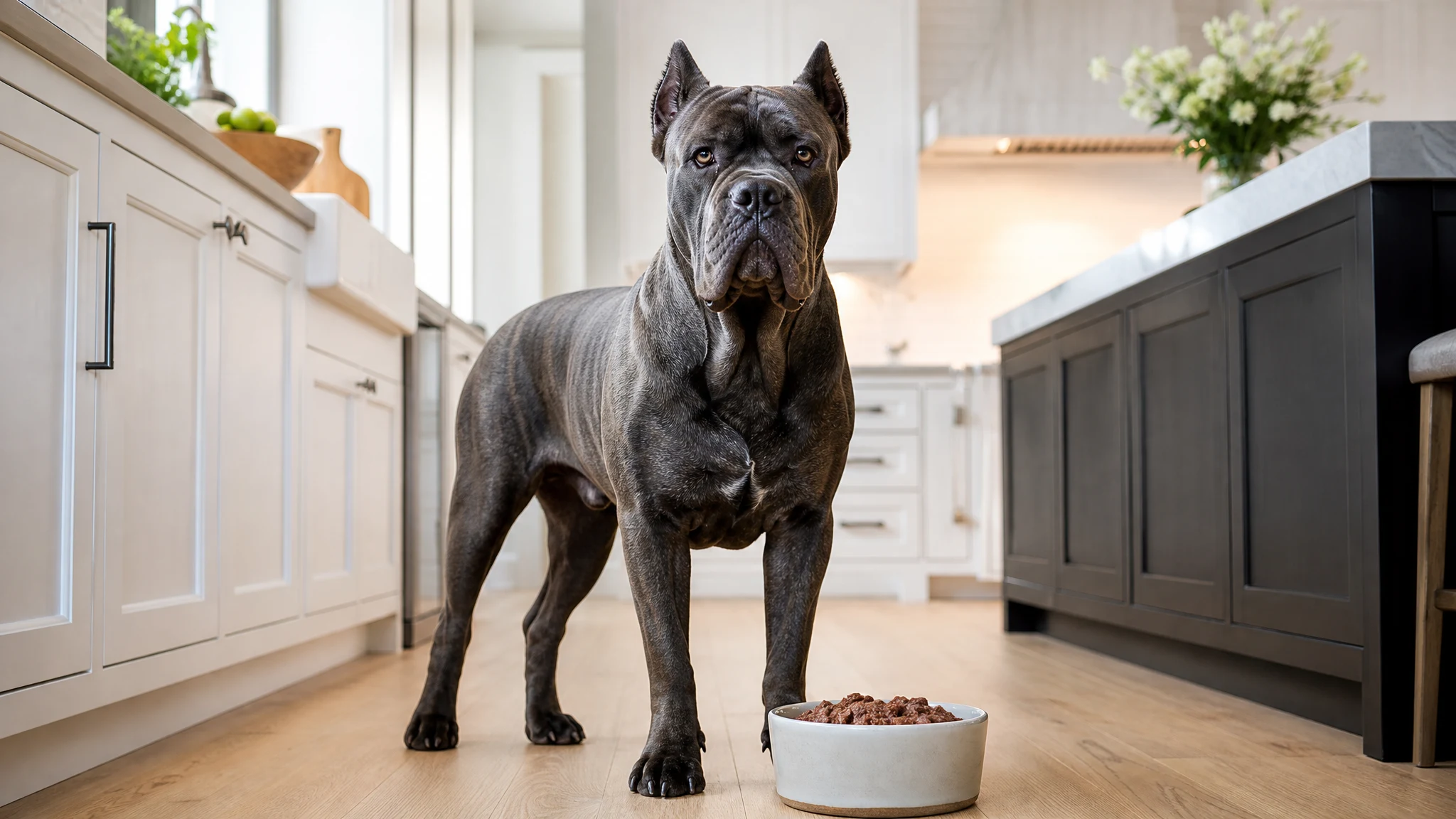
General nutrition information compiled from product labels and published sources, not veterinary advice. Your veterinarian is the right person to choose a diet for your dog, especially one with a health condition.
There is no single best food for every adult Cane Corso. There is a way to pick a sound one, though, and it starts with reading the label instead of the front of the bag.
This guide walks through that process in order. It then compares several large-breed adult foods using label data only. We compared published label information. We did not run feeding trials or taste tests, and nothing here says one food is better for your dog than another.
What an Adult Cane Corso Needs From a Food
Breed information from Chewy's breed education page lists the Cane Corso at 88 to 110 pounds as an adult, with a life expectancy of 9 to 12 years. That puts the breed above the 70 pound adult weight that AAFCO uses for its large-size category, so a large-breed or all-life-stages formula is a sensible starting point.
The same page and the Cane Corso Association of America's CHIC page point to several health topics that touch on diet:
- Bloat (GDV), where a deep chest raises the risk.
- Hip dysplasia and elbow dysplasia.
- Extra weight, which strains the joints.
- Cardiac disease, since CHIC calls for an OFA cardiac evaluation.
No food prevents or treats any of these. What a food can do is help you keep a lean body weight, which is a practical part of daily care. Your veterinarian decides what is right for an individual dog.
The sources we used do not say at what age a Cane Corso counts as an adult for feeding purposes. Ask your veterinarian when to move your dog from a growth food to an adult food. For amounts by age, see our Cane Corso feeding chart by age.
Materials You Need
- The bag, can or package of any food you are considering, or its brand product page.
- A standard 8 ounce measuring cup, or a kitchen scale.
- A notebook or phone note for your dog's weight and food amounts.
- Your dog's current weight and your veterinarian's opinion of their body condition.
Step 1: Confirm the Life Stage on the Label
Find the nutritional adequacy statement, usually in small print near the ingredients. It tells you whether the food is complete and balanced for adult maintenance, growth, or all life stages.
The statement also tells you how the food was backed up. "Animal feeding tests using AAFCO procedures" means the company ran feeding tests. "Formulated to meet the nutritional levels established by the AAFCO Dog Food Nutrient Profiles" means the recipe was matched to the AAFCO nutrient profile on paper. Both are accepted routes, but they are different claims.
For an adult dog, look for "maintenance" or "all life stages." Be careful with the second one. Whole Dog Journal explains that foods for growth or all life stages must say whether they include growth of large-size dogs. A food that says "except for" is not meant for large-breed puppies. An adult Cane Corso is past that stage, but the wording is worth knowing if you share food between dogs.
Step 2: Match the Food to Your Dog's Size
Choose a formula built for large dogs. Check the weight range on the brand page against your own dog. This matters for a big Cane Corso.
- Hill's Science Diet Adult Large Breed lists an ideal adult weight of 55 to 110 pounds.
- Royal Canin Size Health Nutrition Large Adult lists 56 to 100 pounds.
A male Cane Corso can sit above the Royal Canin range. That does not make the food wrong, but it is a good question for the brand or your veterinarian.
Step 3: Read the First Five Ingredients
Ingredients are listed by weight before cooking, so the first few tell you the base of the recipe. Do not treat a long ingredient list or a short one as a quality score. Use it to spot things your dog should avoid and to understand what the food is built from.
Be skeptical of front-of-bag phrases such as "premium" or "natural." They are not nutrition measures. A "by-product meal" or "grain" in the list is not automatically a problem, and a famous ingredient is not automatically a benefit.
Step 4: Compare Protein, Fat and Calories
The table below shows label data from each brand's own product page. Royal Canin and Victor publish guaranteed analysis minimums. Hill's pages in our research gave only dry matter averages, which are not minimums and cannot be compared directly with the other numbers.
| Food | Life stage statement | First five ingredients | Protein | Fat | Calories per cup |
|---|---|---|---|---|---|
| Hill's Science Diet Adult Large Breed Chicken & Barley | Adult maintenance, feeding tests | Chicken, cracked pearled barley, brown rice, brewers rice, whole grain wheat | 23.8% (dry matter average) | 15% (dry matter average) | 365 kcal |
| Royal Canin Size Health Nutrition Large Adult | Adult maintenance, formulated to AAFCO profile | Chicken by-product meal, brewers rice, wheat, brown rice, chicken fat | 24.0% min | 15.0% min | 360 kcal ME |
| Victor Elite Canine | All life stages, formulated to AAFCO profile | Chicken meal, whole grain brown rice, grain sorghum, peas, chicken fat | 25.0% min | 14.0% min | 386 kcal |
Two older-dog options exist from the same brands. Hill's Science Diet Adult 6+ Large Breed lists 352 kcal per cup, and Royal Canin Size Health Nutrition Large Aging 8+ lists 308 kcal per cup. Both are labeled for maintenance. Ask your veterinarian before switching a senior dog to either, since an older dog's needs depend on health and activity.
Notice the calorie spread. Victor Elite Canine has about 21 more calories per cup than Royal Canin Large Adult. If you swap foods and keep the same cup count, your dog's intake changes. That is why Step 6 matters.
A note on the fresh and wet options
Some formulas are not built for a Cane Corso. Hill's Science Diet Adult Chicken & Barley canned food and Freshpet Complete Nutrition Chicken Recipe are both all-size adult formulas, not large-breed ones. The Freshpet recipe is for adult maintenance and is not a growth formula, so it is not suitable for a puppy. Daily amounts also run high for a big dog, and Freshpet must stay refrigerated and be used within 7 days of opening. A can or roll can still be a topper or a part of the plan, but ask your veterinarian first.
Step 5: Check Heart-Health Questions With Your Veterinarian
The FDA's investigation into a possible link between certain diets and canine dilated cardiomyopathy (DCM) is a topic many owners ask about. The FDA's page was last updated December 23, 2022, and the agency said it did not plan further public updates until there is meaningful new scientific information. The last substantive status report was dated June 27, 2019. We did not find a newer FDA update, but we cannot confirm none exists, so check the FDA page directly.
The CCAA's CHIC page lists a cardiac evaluation among the recommended health tests for the breed. If you have concerns about your dog's heart, talk to your veterinarian rather than choosing a food on your own.
Step 6: Start From the Label Guide, Then Adjust
Every brand's feeding chart is a starting point. Hill's says to adjust amounts as needed to maintain optimal weight. Here is what we found on the label pages:
- Royal Canin Large Adult lists cups and grams per day by target weight and activity. A 62 pound dog with low activity is listed at 3 cups (290 g). That is below a typical Cane Corso weight, so read the chart for your own dog's target weight.
- Victor Elite Canine charts adult amounts by weight. For dogs over 100 pounds, the label says to add 1/2 cup for every 20 pounds above 100.
- Hill's Science Diet pages point owners to their veterinarian if they are unsure.
Weigh your dog every few weeks and write it down. If the dog gains or loses weight you did not plan for, change the portion in small steps and ask your veterinarian what a healthy target is.
Step 7: Switch Foods Gradually
When changing foods, mix the new food into the old one over about a week, increasing the new share each day. A slow change is easier on the stomach. The brand pages we reviewed gave no switching schedule, so treat this as general practice and confirm it with your veterinarian.
Tips and Common Mistakes
- Using a puppy food for an adult. Growth foods are built for growing dogs. Ask your veterinarian when to switch.
- Using the wrong cup. Victor's guide assumes a standard 8 ounce cup. A scoop from a different set can shift the amount.
- Comparing different kinds of numbers. Dry matter averages and guaranteed analysis minimums are not the same measure.
- Ignoring treats. They add calories. Count them in the daily total.
- Judging by the price or the bag. We did not compare prices, and the label is the better guide.
- Treating food as medicine. Prescription diets come only from a veterinarian.
What to Expect
With a complete and balanced adult food, appropriate portions and regular weigh-ins, many owners find it easier to keep their dog at a steady, lean weight. Results vary by dog, and diet is only one part of joint, heart and digestive health. Your veterinarian is the right person to judge how your Cane Corso is doing.
Where to Check the Details
Label wording can change, and several statements in our research were incomplete. Check each statement on the brand page before you buy. For a specific question on Hill's Science Diet, Royal Canin or Victor, contact the brand directly.
Sources
- Cane Corso Association of America, CHIC page
- Whole Dog Journal, nutritional adequacy statements
- FDA CVM, DCM investigation page
- Hill's Science Diet Adult Large Breed product page
- Hill's Science Diet Adult 6+ Large Breed product page
- Royal Canin Size Health Nutrition Large Adult product page
- Royal Canin Size Health Nutrition Large Aging 8+ product page
- Victor Elite Canine product page
- Freshpet Complete Nutrition Chicken Recipe product page