Wet vs Dry vs Fresh Food for Cane Corsos
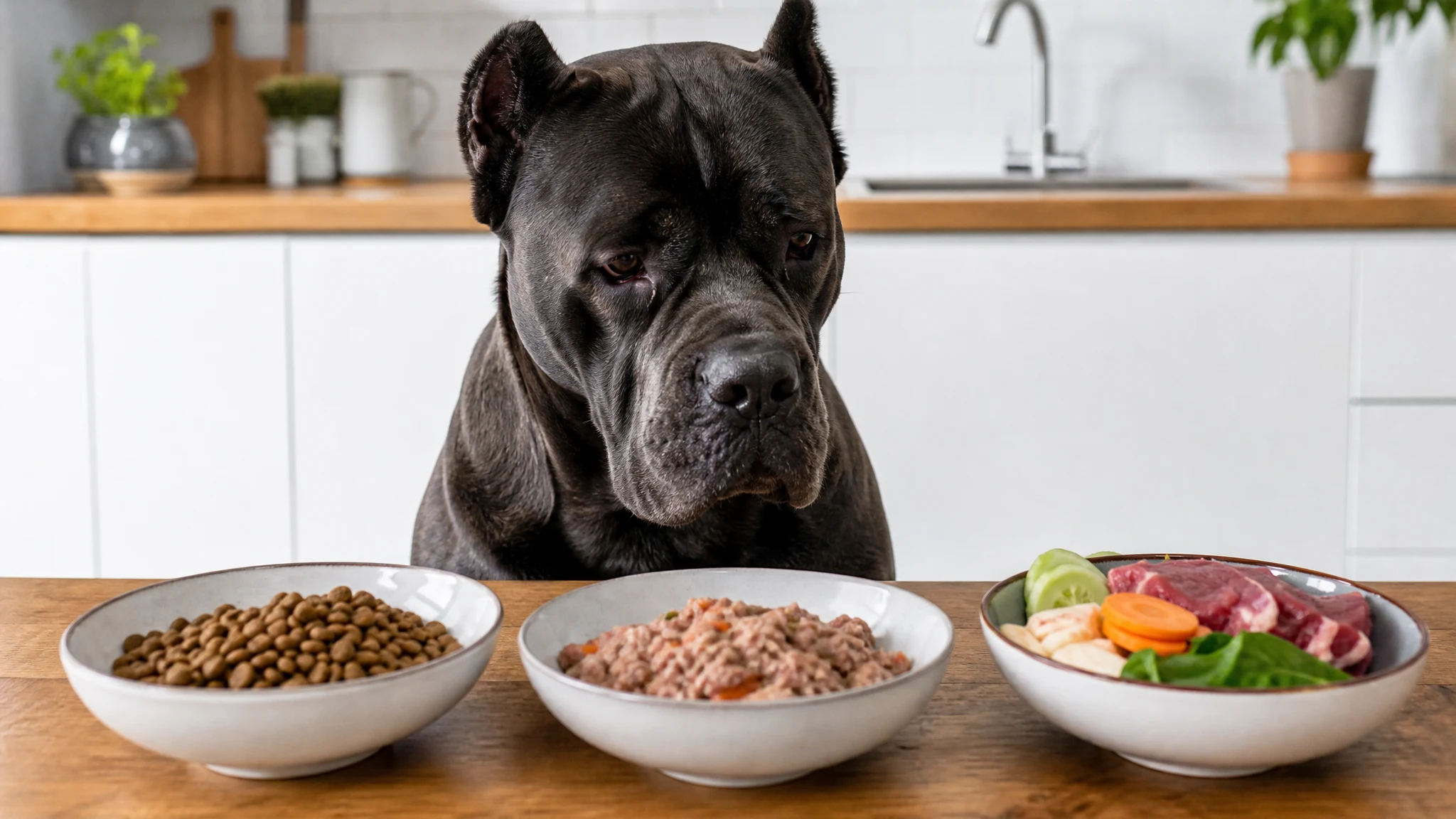
General nutrition information compiled from product labels and published sources, not veterinary advice. Your veterinarian is the right person to choose a diet for your dog, especially one with a health condition.
Most Cane Corso owners end up asking the same question. Is wet vs dry dog food the real choice, or does fresh food belong in the conversation too? The honest answer is that the form of the food matters less than what the label says about life stage, size and calories.
This page compares the three forms using the label data published by the brands. We compared label data only. We did not run feeding trials or taste tests, and we are not claiming any food works better for a particular dog.
Why a Cane Corso changes the question
Chewy's breed education page lists the adult Cane Corso at 88 to 110 pounds, with a life expectancy of 9 to 12 years. That puts the breed well above the 70 pound adult weight that the American Association of Feed Control Officials (AAFCO) uses to define large-size dogs.
That size matters for three reasons.
- Volume. A big dog eats a lot, so a food's form changes how much you scoop, open or slice every day.
- Puppy growth. Whole Dog Journal notes that too much calcium can harm large-breed puppies, and says to feed a growth food labeled for large-size dogs.
- Weight and joints. The Cane Corso Association of America's CHIC page lists hip dysplasia and elbow dysplasia among the breed's health screening concerns. Chewy's breed page notes that extra weight strains the joints. Counting calories matters in every form.
Chewy's breed page also lists bloat (gastric dilatation-volvulus) as a risk for deep-chested dogs. None of the sources we reviewed say that wet, dry or fresh food changes that risk. If bloat worries you, ask a veterinarian about feeding routines and prevention.
How the three forms compare on the label
The examples below come from the brands' own product pages. They are not a ranking. The numbers are not directly comparable in every row, because some brands publish guaranteed minimums and others publish dry matter averages.
| Attribute | Dry | Wet (canned) | Fresh (refrigerated roll) |
|---|---|---|---|
| Examples compared | Hill's Science Diet Adult Large Breed, Royal Canin Size Health Nutrition Large Adult, Victor Elite Canine | Hill's Science Diet Adult Chicken & Barley Entree | Freshpet Complete Nutrition Chicken Recipe with Wholesome Grains & Carrots |
| Moisture clue on the label | Water is not an ingredient in the lists we reviewed | Water is the first ingredient | Chicken broth is the second ingredient |
| Calories | 352 to 386 kcal per standard cup across the dry foods reviewed | 369 kcal per 13 oz can | 308 kcal per half pound (calculated, 1,357 kcal/kg) |
| Large-breed or size-specific options | Yes, in puppy, adult and senior versions | The Hill's entree is an all-size adult formula, not a large breed formula | The Freshpet recipe is an all-size adult formula |
| Growth (puppy) option in this comparison | Yes | No | No. The label is adult maintenance only |
| Storage note on the label | Not stated in our data | Not stated in our data | Keep refrigerated, use within 7 days of opening |
| Kibble size | Mostly not published | Not applicable | Not applicable |
The dry foods in that calorie range include Royal Canin Large Adult at 360 kcal per cup, Hill's Adult Large Breed at 365, and Victor Elite Canine at 386. Cups also differ between brands, so check how each company defines a serving.
Dry food: pros and cons
Dry food is the form with the most large-breed choices. Hill's, Royal Canin and Victor each publish large-breed dry formulas on their own pages.
Pros
- The only growth options in this comparison. Hill's Science Diet Puppy Large Breed, Royal Canin Size Health Nutrition Large Puppy and Victor Hi-Pro Plus Large Breed Puppy are all dry. The Royal Canin and Victor labels say they are formulated for growth including growth of large-size dogs (70 pounds or more as an adult). The Hill's page gives an AAFCO feeding test statement for growing puppies.
- Guaranteed analysis is easy to find. Royal Canin and Victor publish minimum protein and fat and maximum fiber. For example, Royal Canin Large Adult lists 24 percent protein, 15 percent fat and 3.2 percent fiber, and Victor Elite Canine lists 25, 14 and 4 percent.
- Measuring is simple. Victor and Royal Canin give amounts in cups per day. For instance, Royal Canin's page lists a 62 pound dog with low activity at 3 cups (290 g) per day.
Cons
- Kibble size is a blank. The pages we reviewed mostly do not publish it. Royal Canin Large Adult says only that it is designed for large jaws. Victor Hi-Pro Plus says it includes appropriate kibble size for large breeds. Neither gives dimensions, so ask the brand if your dog has trouble with a particular kibble.
- Easy to overfeed. A big scoop of calorie-dense food adds up quickly. Victor Elite Canine lists 386 kcal per cup, and the label guides tell you to adjust amounts to keep your dog at an optimal weight.
- Ingredient lists vary a lot. Some of the dry foods list chicken by-product meal first, others list whole chicken. Neither is automatically better or worse, but the lists are worth reading line by line.
Wet food: pros and cons
If you are weighing wet food for Cane Corsos specifically, the label data raises one practical point first: it is mostly water, so the volume adds up.
Pros
- Water is the first ingredient. The Hill's Science Diet Adult Chicken & Barley Entree lists water, then chicken, pork liver, whole grain corn and cracked pearled barley. That makes it a way to add moisture to a meal.
- Simple, visible ingredients. The dry matter averages on the Hill's page are protein 26.7 percent, fat 16.7 percent and crude fiber 1 percent. These are averages, not guaranteed minimums.
- A complete-diet statement for adults. Hill's states that AAFCO feeding tests substantiate complete and balanced nutrition for adult maintenance.
Cons
- Not a large breed formula. The Hill's entree is an all-size adult recipe. It is not a puppy food, and we found no wet large-breed formula from the brands we compared.
- The can count grows fast. Hill's lists a 50 pound dog at 3 1/4 cans per day. A Cane Corso at 88 to 110 pounds is considerably heavier, so expect the chart to call for more cans. Check the full feeding chart on Hill's page.
- Cost adds up in general terms. Brands publish no price on these pages, and prices vary by store. Still, a 13 oz can holds 369 kcal while a cup of dry food holds roughly the same. A large dog fed mostly from cans needs many cans a day, so daily cost for wet food is usually higher than for dry. Work out a per-day figure from your own receipts.
Fresh food: pros and cons
Pros
- Short ingredient list you can read. The Freshpet Complete Nutrition Chicken Recipe lists chicken, chicken broth, brown rice, rice bran and carrots as its first five ingredients.
- Flexible portions. You slice off the amount shown on the serving marks. Freshpet's page lists 1 1/2 pounds a day for dogs 61 pounds and up, plus 1/4 pound for every additional 25 pounds over 60.
- Complete-diet statement. The label says it is formulated to meet AAFCO nutrient levels for adult maintenance.
Cons
- Adult only. Freshpet's recipe is not a growth formula, so it is not suitable for a Cane Corso puppy.
- Refrigeration and a clock. The page says to keep it refrigerated and use it within 7 days of opening. A large dog goes through a lot, so check the storage room you will need.
- Calories need checking. The page publishes no per-cup or per-roll figure, only 1,357 kcal/kg (calculated). The guaranteed analysis shows lower percentages (7.5 percent protein, 7 percent fat, 1.5 percent fiber) than dry foods, but that is because the moisture is included, not because the food is weaker.
- Cost in general terms. No price is listed. Like wet food, a fresh product is mostly water and a Cane Corso needs a big weight of it per day, so ask yourself whether the daily total fits your budget over a lifespan of 9 to 12 years.
Dental myths
A common belief is that dry food cleans teeth and wet food ruins them. None of the label data we compared makes a dental claim for any of these products, and none of the breed sources we reviewed address tooth health by food form. Take any dental promise on a bag or a can with caution.
If you are worried about your dog's mouth, ask a veterinarian to look. They can say what is right for an individual dog, which a feeding form cannot.
Mixing forms
Many owners add a spoonful of wet or fresh food to dry kibble. The brand pages we reviewed do not give mixing instructions, so there is no label basis for ratios. Some things follow from what the labels do say.
- Count it as calories. Hill's tells owners to adjust amounts to maintain optimal weight. A topper adds calories, so reduce the base food if the dog is gaining.
- Match the life stage. For a puppy, the main food should carry a large-breed growth or all-life-stages statement. Mixing in an adult-only product such as the Freshpet recipe does not turn the meal into a balanced puppy diet.
- Mind storage. Opened fresh food follows its own 7 day clock.
For a measured plan, ask a veterinarian how to portion a mixed bowl for your dog.
Best for: use cases
- Cane Corso puppy: Dry large-breed growth food. It is the only form with large-size growth labels in this comparison. Look for the AAFCO wording about growth of large-size dogs.
- Healthy adult on a routine: Dry large-breed adult food is the easiest to measure. Examples reviewed include Hill's Adult Large Breed, Royal Canin Large Adult and Victor Elite Canine.
- Adding moisture or variety to an adult's meal: A wet or fresh adult food used as a measured topper, with the dry portion reduced to match.
- Senior dog: Large-breed senior dry formulas exist from Hill's (6+) and Royal Canin (8+). No wet or fresh senior large-breed option appears in the sources we compared.
- Dog with a medical need: A veterinarian decides. Prescription diets are available only from a veterinarian, and no food form here prevents, treats or cures any disease.
A note on grain-free and the FDA
None of the foods compared here are grain-free. Cardiac disease is on the CHIC list for the breed, which includes an OFA cardiac evaluation. The FDA's page on its investigation into diets and canine dilated cardiomyopathy was last updated December 23, 2022. The FDA said it does not plan further public updates without meaningful new science. Diet questions tied to the heart belong with a veterinarian.
Verdict
For most Cane Corso households, a large-breed dry food is the practical foundation. The reasons are plain. It is the only form with large-breed growth labels in this comparison, it publishes the clearest nutrient minimums, and it is the simplest to portion.
Wet and fresh foods are reasonable adult options if your dog does well on them and your budget and fridge allow. Neither is a puppy food in the products compared. For an adult, the most workable use of either is often as a measured addition to a dry base, with calories counted.
The best choice is the one that carries the right life-stage statement, keeps your dog at a lean weight and that you can afford every day. If you want to see how specific formulas stack up, read our comparison of foods by label data. Then check the numbers on the brand pages below, and ask your veterinarian before changing your dog's diet.
Sources
- Chewy breed education page for the Cane Corso (adult weight, life expectancy, bloat and obesity notes)
- Cane Corso Association of America, CHIC page
- Whole Dog Journal, nutritional adequacy statements
- FDA Center for Veterinary Medicine, DCM investigation page
- Hill's Science Diet Puppy Large Breed
- Hill's Science Diet Adult Large Breed
- Hill's Science Diet Adult Chicken & Barley Entree (canned)
- Royal Canin Size Health Nutrition Large Adult
- Royal Canin Size Health Nutrition Large Puppy
- Victor Hi-Pro Plus Large Breed Puppy
- Victor Elite Canine
- Freshpet Complete Nutrition Chicken Recipe with Wholesome Grains & Carrots