Best Dry Dog Food for Large-Breed Puppies: Transitioning From Milk to Kibble
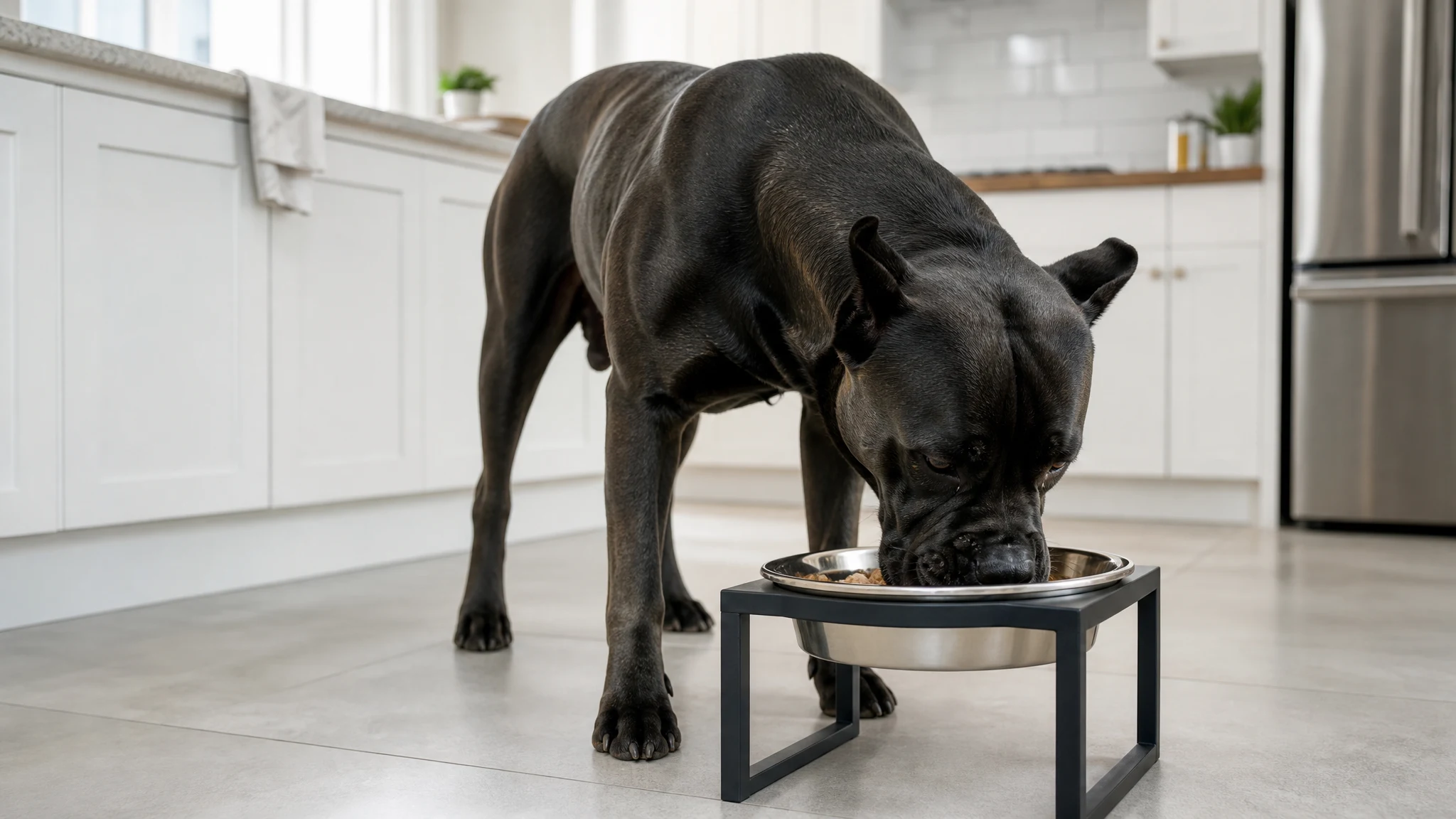
General nutrition information compiled from product labels and published sources, not veterinary advice. Your veterinarian is the right person to choose a diet for your dog, especially one with a health condition.
A Cane Corso puppy grows fast, and the food you choose while the puppy moves off milk matters. This guide covers how to make that change gradually, and how to read the label on a dry food so you pick one made for large-breed growth.
An adult Cane Corso is a big dog. A Chewy breed education page lists adult weight at 88 to 110 pounds. That is well above the 70 pound mark the Association of American Feed Control Officials (AAFCO) uses for large-size dogs. So a Cane Corso puppy needs a food labeled for large-size growth.
How we approached this
We compared label data from the brands' own product pages. We did not run feeding trials or taste tests, and we cannot say how any one food will suit your puppy. For a wider look at adult, puppy and senior options, see our Cane Corso foods compared by label data.
None of the pages we read give an age for weaning a Cane Corso. Ask the breeder or your veterinarian when your puppy is ready to start solid food. Also ask whether milk should come from the mother or from a puppy milk replacer.
What you will need
- A dry food labeled for large-breed puppies (see the label checks below)
- A standard 8 ounce measuring cup, or a kitchen scale
- Warm water
- A shallow, wide bowl that is easy to reach into
- Fresh water in a separate bowl
- A notebook or phone note to track meals and weight
- Your veterinarian's contact details
Step 1: Choose a food made for large-breed growth
Start with the nutritional adequacy statement on the bag. The Whole Dog Journal explains that growth and all-life-stages foods must state whether they include or exclude growth of large-size dogs, meaning dogs of 70 pounds or more as adults. Foods labeled "including" are considered appropriate for large-breed puppies. Foods labeled "except for" are not.
The same source notes that too much calcium can harm large-breed puppies. That is why a general puppy food is not a safe default for this breed.
Here is what the brands' own pages say about three large-breed puppy options. Treat this as label data only, not a ranking.
| Food | Label wording on growth | First ingredients | Calories |
|---|---|---|---|
| Hill's Science Diet Puppy Large Breed Chicken & Brown Rice | Feeding tests using AAFCO procedures substantiate complete and balanced nutrition for growing puppies. Made for large-breed puppies up to 18 months. | Chicken, brown rice, whole grain oats, chicken meal, cracked pearled barley | 387 kcal per cup |
| Royal Canin Size Health Nutrition Large Puppy | Formulated to meet AAFCO nutrient levels for growth, including growth of large-size dogs. Made for adult weights of 56 to 100 pounds, up to 15 months. | Chicken by-product meal, corn, wheat, chicken fat, wheat gluten | 349 kcal ME per cup |
| Victor Hi-Pro Plus Large Breed Puppy | Labeled for All Life Stages, including growth of large-size dogs. | Chicken, chicken meal, brown rice, whole grain millet, whole grain sorghum | 365 kcal per cup |
Royal Canin lists a minimum of 28 percent protein, 14 percent fat and a maximum of 3.7 percent fiber. Victor lists minimums of 30 percent protein and 14 percent fat, and a maximum of 6 percent fiber. Hill's gives dry matter averages instead of minimums, so the numbers are not directly comparable. Confirm the exact statement on the bag in your hands.
One note on Giant Puppy formulas: Royal Canin makes one, but its page describes it as a giant-breed food. Ask your veterinarian whether it or a large-breed formula fits your puppy better.
The pages we read do not state kibble size. If your puppy struggles with the pieces, check with the brand or your veterinarian.
Step 2: Prepare a soft starter mix
Put a small portion of the dry food in the bowl. Add warm water and let it sit until the kibble softens and turns mushy. Many puppies accept this more readily than hard pieces.
Offer it at a comfortable temperature, not hot. Check it with a clean finger first.
Step 3: Introduce it alongside milk
Do not remove milk all at once. Offer the softened food first, then the usual milk feeding. Let the puppy sniff and lick. Some puppies make a mess for the first few meals, and that is normal.
Do not force the puppy's face into the bowl. Keep meals calm and positive. Praise and a gentle voice are enough.
Step 4: Increase solid food a little at a time
Over several days, offer a bit more softened kibble and a bit less milk at each meal. Watch the puppy's stool and energy. If stools turn loose or the puppy seems unwell, slow down and call your veterinarian.
Gradually use less water, so the kibble moves from mushy to moist and then to dry. Keep fresh water available throughout.
Step 5: Set a meal schedule
Brands differ on how they present amounts, so start with the label for your food.
- Victor Hi-Pro Plus Large Breed Puppy: The brand's page lists feeding amounts by age group and body weight, using a standard 8 ounce cup. Read the chart on the page for your puppy's current weight and age.
- Royal Canin Large Puppy: The page points to a feeding calculator and does not list amounts as text. Use the calculator on the brand's site.
- Hill's Puppy Large Breed: The page says to adjust feeding amounts as necessary to maintain optimal weight, and to ask your veterinarian if unsure.
For a related Victor product, Elite Canine, the brand says puppies are fed as much as they will eat in 20 minutes, across four feedings per day. Use that as an example of how a brand frames puppy meals, not as a rule for every food.
Treat every number as a starting point. Divide the daily total into several meals, weigh your puppy regularly, and adjust.
Step 6: Watch weight and growth
A Chewy breed education page notes that extra weight strains joints in Cane Corsos. Hip dysplasia and elbow dysplasia appear on the Cane Corso Association of America's CHIC health testing page. Bloat, also called GDV, is described as a risk for deep-chested dogs.
No food prevents or treats these conditions. What you can do is feed measured amounts, track weight, and keep your veterinarian involved. Ask them about feeding schedule and portion size, especially if your puppy has a health condition. A veterinarian decides what is right for an individual dog.
Tips for a smoother transition
- Change only one thing at a time. Do not switch brands in the middle of weaning.
- Measure meals. Scooping by eye drifts upward over time.
- Keep mealtimes quiet and consistent.
- Write down the brand, formula and lot on the bag in case you need to discuss it with your veterinarian.
- Count treats as part of the day's food.
Common mistakes to avoid
- Using an adult or all-size food. Hill's adult Chicken & Barley canned food, for example, is an all-size adult formula, not a large-breed one. Freshpet's chicken roll is labeled for adult maintenance and is not a growth formula, so it is not suited to a Cane Corso puppy.
- Ignoring the "except for" wording. If the statement excludes growth of large-size dogs, move on.
- Overfeeding to speed up growth. Faster is not better for a large-breed puppy.
- Adding supplements on your own. Ask your veterinarian first. We do not give doses.
- Skipping the vet. If the puppy refuses food, vomits, or has persistent diarrhea, call your veterinarian.
What to expect
Many puppies take to softened kibble within days, though some need longer. A gradual change may help reduce stomach upset, but each puppy responds differently. Expect some mess, some refusal, and some loose stools along the way.
Over the following weeks, a steady routine often leads to regular meals and a puppy who eats dry food without soaking. We cannot promise a result. If your puppy is not gaining steadily or seems unwell, your veterinarian is the right next call.
Later, growth food gives way to an adult food. The pages we read do not say at what age a Cane Corso is considered an adult, so ask your veterinarian before switching.
If you want to see how adult formulas compare once your puppy has grown, our label comparison for Cane Corsos covers more options.
Sources
- Whole Dog Journal: In the Fine Print, Nutritional Adequacy Statements
- Cane Corso Association of America: AKC Canine Health Foundation and CHIC
- Hill's Pet Nutrition: Science Diet Puppy Large Breed
- Royal Canin US: Size Health Nutrition Large Puppy
- Victor Super Premium Pet Food: Hi-Pro Plus Large Breed Puppy
- Victor Super Premium Pet Food: Elite Canine