Best Large-Breed Puppy Formula for a Cane Corso: Why Growth Rate Matters
General nutrition information compiled from product labels and published sources, not veterinary advice. Your veterinarian is the right person to choose a diet for your dog, especially one with a health condition.
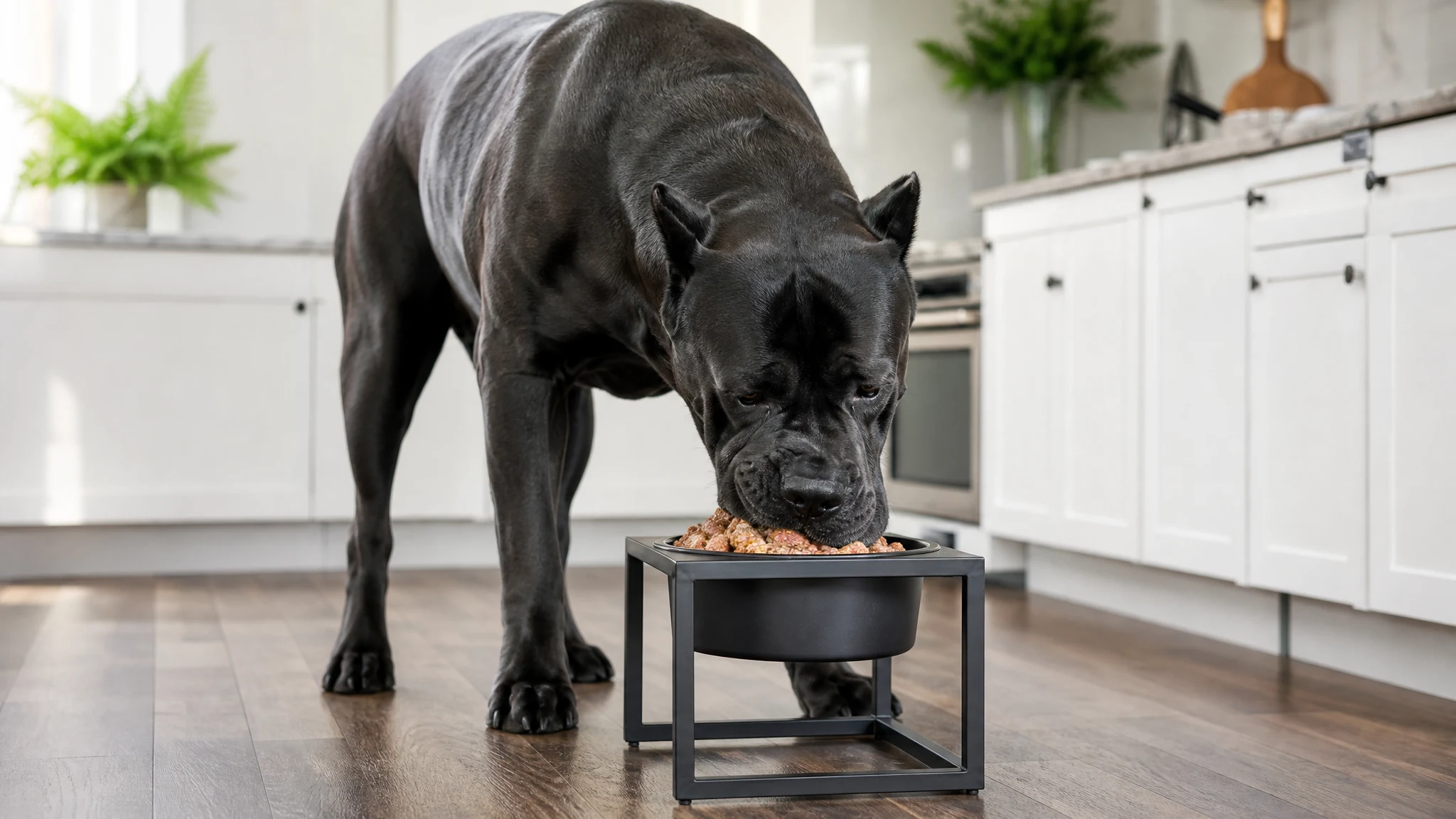
A Cane Corso puppy grows into a big dog. Chewy's breed education page lists adults at 88 to 110 pounds. That puts the breed well above the 70 pound line AAFCO uses for large-size dogs.
So "best" here does not mean a famous brand or a high price. It means a puppy food whose label says it is meant for a dog this size, fed in amounts that keep growth steady. This guide shows how to read a label and how to compare a few options.
Why growth rate matters for this breed
Whole Dog Journal reports that too much calcium can harm large-breed puppies, and that these puppies should eat a growth food labeled for large-size dogs. That is the main reason a generic puppy food is not the safe default for a Cane Corso.
Extra weight is also a concern. Chewy's breed page lists obesity as a breed-relevant issue because extra weight strains the joints. The Cane Corso Association of America, on its CHIC page, lists hip dysplasia and elbow dysplasia among the conditions the breed's health testing addresses. The same page says CHIC requires an OFA cardiac evaluation.
No food can prevent or treat these conditions. What you can do is choose a properly labeled food, measure portions, and keep your puppy lean. Your veterinarian decides what is right for your individual dog.
What you need
- The bag or can of any food you are considering, or its brand product page
- A standard 8 oz measuring cup or a kitchen scale
- Your puppy's current weight and age
- A notebook or phone note for weights and portions
- Your veterinarian's contact details for questions
Step 1: Find the AAFCO adequacy statement
Look for the small print that begins with wording like "formulated to meet the nutritional levels established by the AAFCO Dog Food Nutrient Profiles" or "animal feeding tests using AAFCO procedures substantiate...". It should name a life stage.
Growth and all-life-stages foods are the ones that can suit a puppy. An adult maintenance statement means the food is not meant for growth.
Step 2: Check the large-size wording
According to Whole Dog Journal's explanation of AAFCO labeling, growth and all-life-stages foods must state whether they include or exclude growth of large-size dogs (70 pounds or more as an adult). Foods labeled "including" are considered appropriate for large-breed puppies. Foods labeled "except for" are not.
For a Cane Corso, look for the "including" wording. If the statement is unclear, check the brand's page or ask the brand. Note that Whole Dog Journal is a secondary source, so confirm the exact wording on your own label.
Step 3: Compare the label data side by side
I compared label data published on the brands' own product pages. I did not run feeding trials or taste tests, and the table below is not a ranking. It shows what each label says so you can ask better questions.
| Food | Life stage on the label | First ingredients | Protein / fat | Calories |
|---|---|---|---|---|
| Hill's Science Diet Puppy Large Breed Chicken & Brown Rice | Growing puppies, large breed, up to 18 months | Chicken, brown rice, whole grain oats, chicken meal, cracked pearled barley | 26.7% / 15.4% (dry matter averages, not minimums) | 387 kcal per cup |
| Royal Canin Size Health Nutrition Large Puppy | Growth, including large-size dogs, up to 15 months | Chicken by-product meal, corn, wheat, chicken fat, wheat gluten | 28.0% min / 14.0% min | 349 kcal ME per cup |
| Victor Hi-Pro Plus Large Breed Puppy | All life stages, including growth of large-size dogs | Chicken, chicken meal, brown rice, whole grain millet, whole grain sorghum | 30% min / 14.0% min | 365 kcal per cup |
Two details are worth noting. Hill's publishes dry matter averages, which are not the same as the guaranteed minimums on Royal Canin and Victor labels, so do not compare those numbers directly. Also, Hill's lists average calcium at 1.16% and phosphorus at 0.94% on a dry matter basis. Ask your veterinarian how to read those figures for your puppy rather than judging them on your own.
Royal Canin also makes a Giant Puppy formula. Whether a Cane Corso fits large or giant sizing is a question for your veterinarian, since the brand pages define the sizes by their own ranges. Royal Canin's Large Puppy page lists an adult weight range of 56 to 100 pounds, so check how that lines up with your puppy's expected size.
Step 4: Read the ingredient list with a skeptical eye
Ingredients are listed in order of weight. The first five tell you the main building blocks, but they do not tell you quality. A chicken meal or by-product meal is not automatically better or worse than whole chicken. Whole chicken contains a lot of water before cooking, so its position on the list can look more impressive than it is.
None of the foods above is grain-free. The FDA has an ongoing investigation page on possible links between certain diets and canine dilated cardiomyopathy (DCM). As of the research for this article, the page was last updated December 23, 2022, and the FDA said it did not plan further public updates until there is meaningful new scientific information. I could not confirm whether anything newer exists, so check the FDA page and ask your veterinarian, especially because the Cane Corso club lists cardiac evaluation in its health testing.
Step 5: Match the food to the life stage
Some products on the brands' sites look tempting but are the wrong stage:
- Hill's Science Diet Adult Large Breed and Adult 6+ Large Breed are maintenance foods, not puppy foods.
- Royal Canin Large Adult is labeled for 15 months to 5 years, and Large Aging 8+ is for older dogs.
- Freshpet's Complete Nutrition Chicken Recipe is labeled for adult maintenance, so it is not suited to a Cane Corso puppy.
- Victor Elite Canine is labeled for all life stages and as a large-breed formula. Before using it for a puppy, check the label for the large-size growth wording from Step 2.
The age at which a Cane Corso counts as an adult was not something I could confirm from a breed source. Hill's lists its large-breed puppy food up to 18 months and Royal Canin lists its large puppy food up to 15 months. Ask your veterinarian when to switch for your dog.
Step 6: Start with the label's feeding guide, then adjust
Treat every feeding chart as a starting point. Feed by your puppy's age, current weight and activity level, then adjust.
- Hill's: the page says to adjust amounts as necessary to maintain optimal weight, and to ask your veterinarian if unsure.
- Royal Canin: the Large Puppy page points to a feeding calculator rather than listing amounts as text.
- Victor: Hi-Pro Plus lists amounts by age group and body weight, using a standard 8 oz measuring cup. For Elite Canine, Victor says puppies are fed as much as they will eat in 20 minutes, across four feedings per day. That is the brand's own guidance, and it is a reason to watch your puppy's body condition closely.
For a broader look at portions by age, see our guide on how much to feed a Cane Corso by age.
If your puppy has a health condition, confirm amounts with your veterinarian before relying on any chart.
Step 7: Measure, weigh and keep records
- Measure each meal with the same cup or a scale.
- Weigh your puppy on a regular schedule and write the number down.
- Check body condition by feel. You should be able to feel the ribs under a light layer, without pressing hard.
- If weight climbs faster than your veterinarian expects, reduce portions rather than switching foods in a hurry.
Step 8: Change foods slowly
When you move to a new formula, mix it with the old food over several days, increasing the new share gradually. Watch stools and appetite. Ask your veterinarian if anything looks off. The brands' pages I reviewed did not give a switching schedule, so follow your veterinarian's advice.
Tips and common mistakes
- Buying by breed name. I found no formula labeled specifically for Cane Corsos. Look for the large-size growth wording instead.
- Adding calcium. Whole Dog Journal warns that too much calcium can harm large-breed puppies. Do not add supplements unless your veterinarian tells you to.
- Using an adult food too early. Adult foods are not designed for growth.
- Treating the chart as a rule. A bag's chart is a starting point. Your puppy's body condition is the real guide.
- Ignoring treats. Treats and training rewards add calories. Count them in the day's total.
- Comparing different measures. Dry matter averages and guaranteed minimums are not interchangeable.
- Feeding a large meal right before hard play. Chewy's breed page notes that a deep chest raises bloat (GDV) risk and that a gastropexy can help prevent it. Ask your veterinarian about feeding routines and whether gastropexy is worth discussing.
What results to expect
A suitable large-breed puppy food, measured carefully, may help support steady growth and a lean body condition. It can also make portion control easier to track. It will not guarantee a healthy skeleton, and it cannot prevent or treat hip dysplasia, elbow dysplasia, heart disease or bloat. Genetics, exercise, and regular veterinary care all matter.
Cane Corsos live about 9 to 12 years, according to Chewy's breed page. Good habits started in puppyhood are meant to support the long haul, and your veterinarian can adjust the plan as your dog grows.
Sources
- Whole Dog Journal: In the Fine Print, Nutritional Adequacy Statements
- Cane Corso Association of America: AKC Canine Health Foundation and CHIC
- FDA Center for Veterinary Medicine: Investigation into diets and canine dilated cardiomyopathy
- Hill's Pet Nutrition: Science Diet Puppy Large Breed
- Royal Canin US: Size Health Nutrition Large Puppy
- Victor Super Premium Pet Food: Hi-Pro Plus Large Breed Puppy