Cane Corso Puppy Food: Wet vs Dry for the First Year
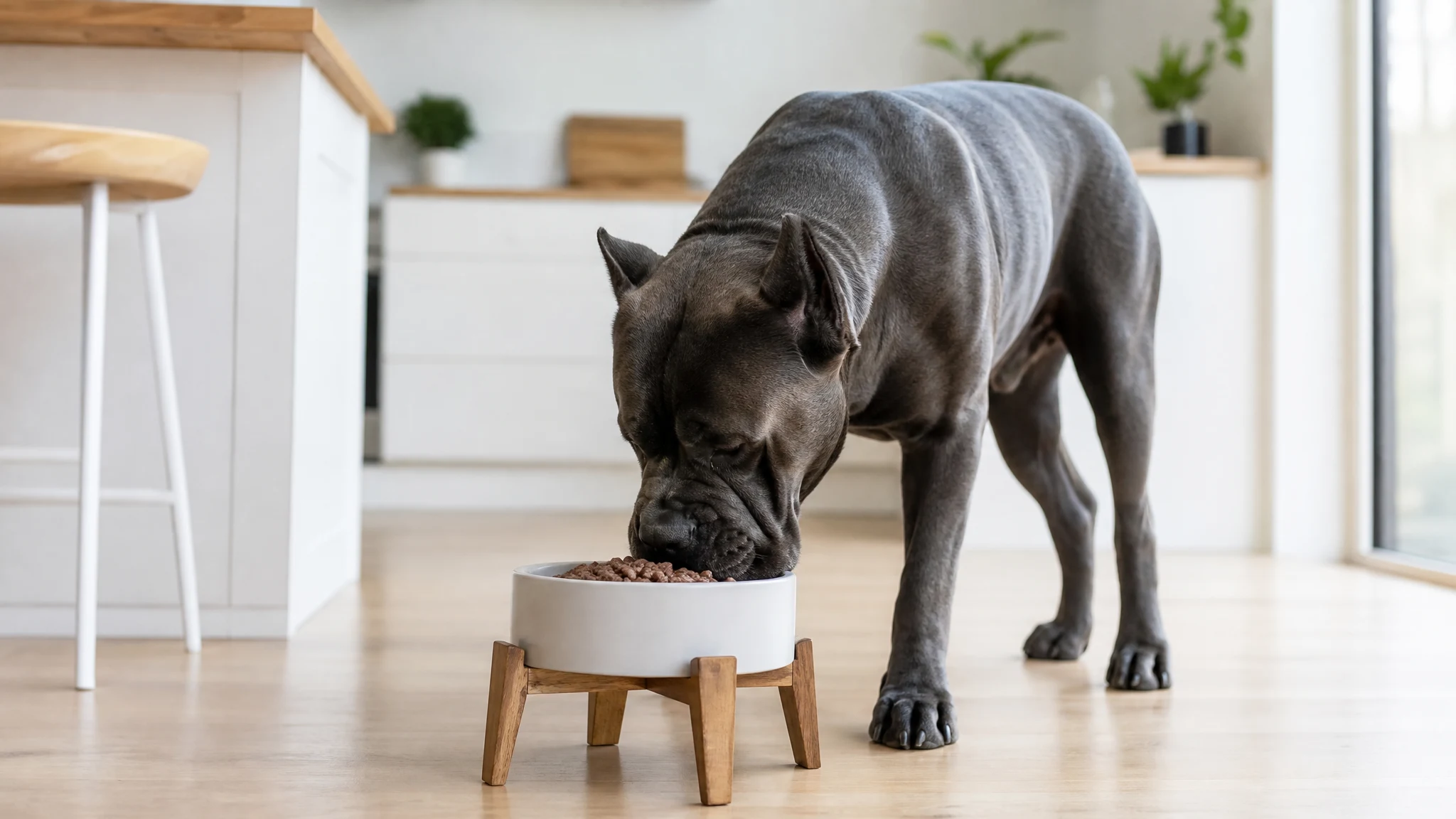
General nutrition information compiled from product labels and published sources, not veterinary advice. Your veterinarian is the right person to choose a diet for your dog, especially one with a health condition.
A Cane Corso puppy will grow into a large dog. Chewy's breed education page lists the adult weight at 88 to 110 pounds. That is above the 70 pound line AAFCO uses to define large-size dogs, so the label on a puppy food matters more than the picture on the bag.
This guide shows how to choose between wet and dry food for the first year, and how to check a label step by step. We compared label data from brand pages. We did not run feeding trials or taste tests, so treat this as a method for reading labels, not a ranking.
What you need before you start
- The bag or can of any food you are considering, or its brand product page.
- Your puppy's current weight and age.
- A standard 8 oz measuring cup and a kitchen scale.
- A notebook or phone note to track weight and meals.
- Your veterinarian's contact details, for questions about your individual puppy.
Step 1: Know what a large-breed puppy food must say
According to Whole Dog Journal, which explains AAFCO label rules, a growth or all-life-stages food must state whether it includes or excludes growth of large-size dogs (70 pounds or more as an adult). A food labeled "including" is considered appropriate for large-breed puppies. A food labeled "except for" is not.
Whole Dog Journal also notes that too much calcium can harm large-breed puppies, and advises a growth food labeled for large-size dogs. This is why an ordinary adult food, wet or dry, is not a good fit for a Cane Corso puppy.
We read this rule from a secondary source, not the AAFCO text itself. Check the exact wording on any food you buy.
Step 2: Understand the wet and dry difference
Dry food is kibble. Wet food is canned and holds a lot of water. That water is why wet food labels can look low in protein next to kibble. To compare fairly you need dry matter figures, which remove the water.
The practical differences for a large puppy come down to volume and handling:
- Dry: compact, easy to measure and easy to store. Calories per cup are printed on brand pages.
- Wet: softer, and many dogs find it appealing. It takes far more volume to supply the same calories. For a sense of scale, Hill's lists its adult Chicken & Barley Entrée canned food at 369 kcal per 13 oz can, and its feeding guide shows a 50 pound adult dog at 3 1/4 cans per day. That is an adult, all-size food, not a puppy food.
A large puppy eating wet food alone would need a lot of cans, and the cost and storage add up. Many owners use wet food as a small topper on a measured dry meal instead. Count it toward the daily total.
Step 3: Check which growth foods are actually available
Large-breed growth formulas in the dry category are easy to find on brand pages. Here is what the brands publish:
| Food (dry) | Label detail from brand page |
|---|---|
| Hill's Science Diet Puppy Large Breed Chicken & Brown Rice | AAFCO feeding-test statement for growth. Made for large-breed puppies up to 18 months. 387 kcal per cup. First ingredients: chicken, brown rice, whole grain oats, chicken meal, cracked pearled barley. |
| Royal Canin Size Health Nutrition Large Puppy | Minimum protein 28%, minimum fat 14%, maximum fiber 3.7%. 349 kcal ME per cup. Listed for adult weights of 56 to 100 lb, up to 15 months. |
| Royal Canin Size Health Nutrition Giant Puppy | Minimum protein 32%, minimum fat 12%, maximum fiber 3.9%. 338 kcal ME per cup. |
| Victor Hi-Pro Plus Large Breed Puppy | Labeled for all life stages including growth of large-size dogs. Minimum protein 30%, minimum fat 14%, maximum fiber 6%. 365 kcal per cup. |
Two notes. First, Royal Canin lists the Large Puppy range at 56 to 100 lb adult weight, while a Cane Corso can reach 110 lb. That is one reason to ask your veterinarian whether the large or giant formula suits your puppy. Second, none of these brands names the Cane Corso specifically on the pages we read, so no food is a "Cane Corso formula."
For wet food, we did not find a large-breed puppy canned food from these brands. Check directly with Hill's and Royal Canin for any wet growth formula before you buy.
Step 4: Read the label in order
- Find the adequacy statement. Look for a growth or all-life-stages claim. Look for "including growth of large size dogs (70 lb. or more as an adult)."
- Note how it was substantiated. Hill's states that AAFCO feeding tests support its puppy food. Others say the food is formulated to meet AAFCO nutrient profiles. Both are legitimate label claims, but they are different claims.
- Read the first five ingredients. They show what the recipe leans on. They do not tell you quality on their own.
- Find calories per cup or per can. You need it to measure portions.
- Compare on equal terms. Compare dry with dry. Do not compare a wet label's protein percentage with kibble's.
Step 5: Set the starting amount and schedule
Use the brand's own feeding guide as a starting point, not a final answer. Guides are set by age and weight, and brands do it differently:
- Victor lists puppy amounts by age group and body weight, using a standard 8 oz cup.
- Royal Canin points to an online feeding calculator for its puppy foods.
- Hill's says to adjust amounts as needed to maintain optimal weight, and to ask your veterinarian if you are unsure.
Victor's Elite Canine page says puppies are fed as much as they will eat in 20 minutes, across four feedings per day. That is a brand guideline for that food, so check your own food's page. Splitting the day into several small meals is a common approach for a young large puppy, and your veterinarian can tell you when to move to fewer meals.
For a month-by-month view, see our Cane Corso feeding chart by age.
Step 6: Transition slowly
When you change foods, mix the new food into the old over several days, increasing the share of the new food a little each day. If you add wet food, introduce it the same way. Keep notes on stool and appetite, and call your veterinarian if something seems off.
Step 7: Weigh and adjust
Weigh your puppy regularly and write it down. The Chewy breed page lists obesity as a concern because extra weight strains the joints. The Cane Corso Association of America's CHIC page lists hip and elbow dysplasia among the conditions in its health screening program. Food is only one factor in these conditions, and no food is a treatment. If your puppy is gaining faster or slower than expected, ask your veterinarian to review the portions.
The same advice applies to bloat. The breed page notes that a deep chest raises the risk, and that a surgical procedure called gastropexy can help prevent it. A veterinarian should advise on feeding routines and prevention for your individual dog.
Tips
- Measure with a cup or scale every time. Scooping by eye drifts upward.
- Count toppers, wet food and training treats toward the daily total.
- Pick one main food and keep it steady while your puppy grows.
- Check the brand page again before reordering, because formulas can change.
Common mistakes to avoid
- Feeding an adult food to a puppy. Freshpet's Complete Nutrition Chicken Recipe, for example, is labeled for adult maintenance, not growth, so it does not fit a puppy. The Hill's adult canned food is an all-size adult formula too.
- Using wet food alone without counting calories. It is easy to over- or underfeed by the can.
- Trusting the front of the bag. Marketing words are not label statements. Read the adequacy statement.
- Switching adult food too early or too late. We did not find a published age at which a Cane Corso counts as an adult. Hill's lists its puppy food up to 18 months and Royal Canin lists up to 15 months, so ask your veterinarian when to change.
- Adding calcium or other supplements on your own. A complete growth food is already balanced, and extra calcium can be a problem for large puppies. Ask your veterinarian before adding anything.
What to expect
A food that matches the large-breed growth label, measured carefully and adjusted by weight checks, may help your puppy grow at a steady pace. Results vary by dog. Appetite, stool quality and energy are worth tracking.
The FDA's investigation page on diets and canine dilated cardiomyopathy (DCM) was last updated December 23, 2022, and the FDA said it does not plan further public updates until there is meaningful new scientific information. We could not confirm whether anything newer exists. The CHIC program asks for a cardiac evaluation, so if you have heart questions, talk to your veterinarian.
If your puppy has a health condition, confirm all amounts and food choices with your veterinarian. Prescription diets are something only a veterinarian prescribes.
Sources
- Whole Dog Journal: In the Fine Print, Nutritional Adequacy Statements
- Cane Corso Association of America: AKC Canine Health Foundation CHIC page
- FDA CVM: Investigation into diets and canine dilated cardiomyopathy
- Hill's Pet Nutrition: Science Diet Puppy Large Breed
- Hill's Pet Nutrition: Science Diet Adult Chicken & Barley Entrée
- Royal Canin US: Size Health Nutrition Large Puppy
- Royal Canin US: Size Health Nutrition Giant Puppy
- Victor: Hi-Pro Plus Large Breed Puppy
- Victor: Elite Canine
- Freshpet: Complete Nutrition Chicken Recipe with Wholesome Grains & Carrots