How a Cane Corso's Feeding Amounts Change From 8 Weeks to 2 Years
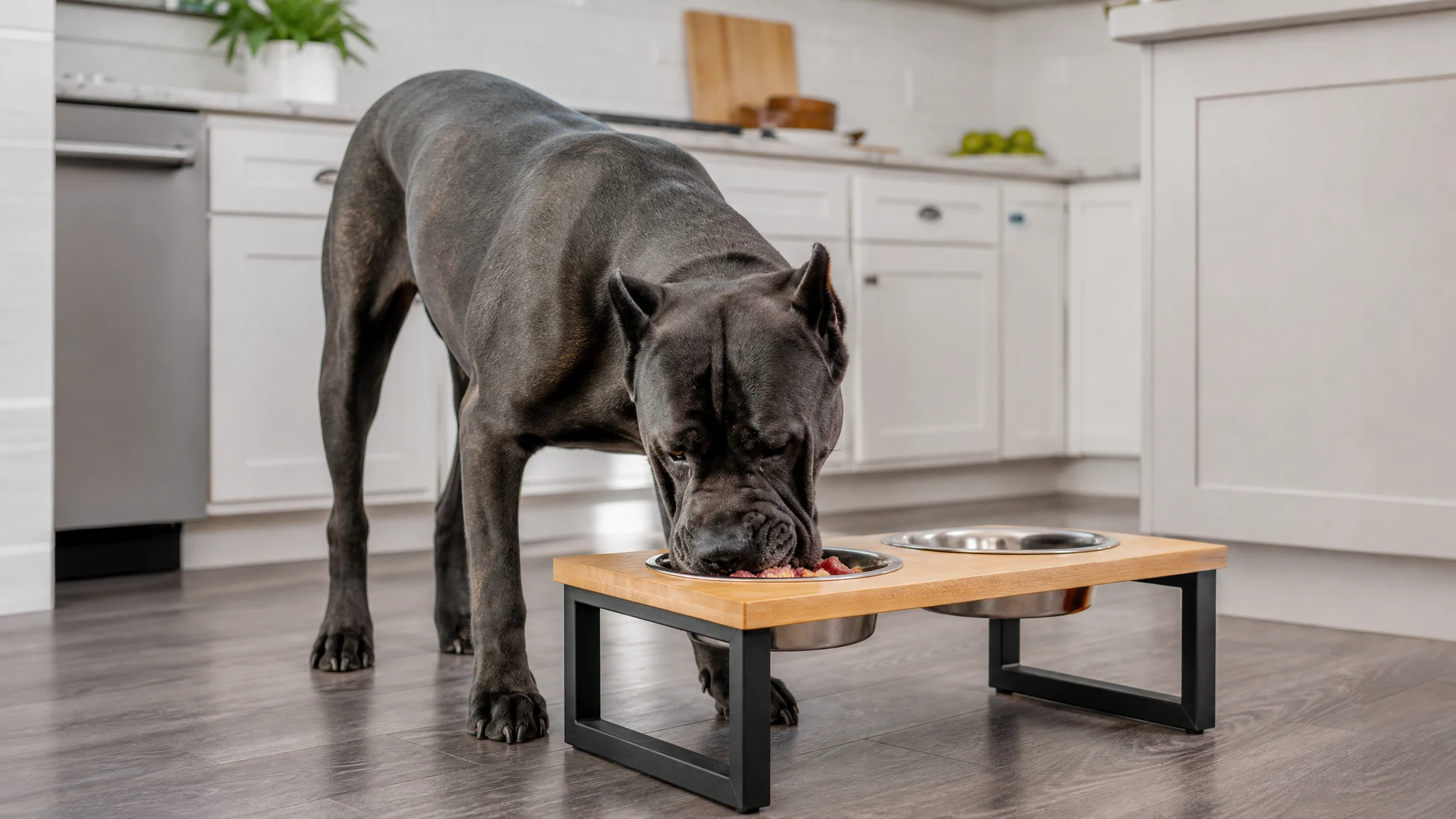
General nutrition information compiled from product labels and published sources, not veterinary advice. Your veterinarian is the right person to choose a diet for your dog, especially one with a health condition.
A Cane Corso puppy goes from a few pounds to a dog in the range of 88 to 110 pounds, according to the Chewy breed education page. Over that stretch the right amount of food keeps moving. The food itself changes too.
This guide walks through how to set a starting amount, adjust it as your dog grows, and avoid the usual mistakes. It relies on what manufacturers print on their own labels and feeding guides. Those are starting points, not promises about your individual dog.
What changes between 8 weeks and 2 years
Three things shift at once: the type of food, the amount, and the number of meals.
The Whole Dog Journal explains that growth and all-life-stages foods must state whether they include or exclude growth of large-size dogs, meaning dogs of 70 pounds or more as adults. A food labeled "including" is considered appropriate for large-breed puppies. A food labeled "except for" is not. A full-grown Cane Corso is well above that 70 pound line, so this wording matters from the first day you bring a puppy home.
The same source notes that too much calcium can harm large-breed puppies, which is why a growth food made for large-size dogs is the safer label to look for.
Obesity is another concern. The Chewy breed education page lists extra weight as a strain on the joints, and the Cane Corso Association of America lists hip and elbow dysplasia among the conditions in its health testing program. Food does not prevent those conditions. But keeping a growing dog lean is something you control, and a veterinarian can tell you what lean looks like on your dog.
What you will need
- A large-breed puppy food, or an all-life-stages food whose statement includes growth of large-size dogs
- A standard 8 ounce measuring cup, or a kitchen scale that reads in grams
- The feeding chart printed on your chosen bag or on the brand's own product page
- A bathroom scale or a vet-office scale to track your dog's weight
- A notebook or phone note for weights, portions and treats
- Your veterinarian's contact details, for questions about your individual dog
Step 1: Pick a food made for large-size growth
Read the nutritional adequacy statement on the bag. For a puppy, look for wording that covers growth including large-size dogs (70 pounds or more as an adult).
Some label examples from the brands' own pages:
- Royal Canin Size Health Nutrition Large Puppy states it is formulated to meet AAFCO nutrient levels for growth including growth of large size dogs. The brand lists its adult weight range as 56 to 100 pounds and the feeding period as up to 15 months.
- Victor Hi-Pro Plus Large Breed Puppy is labeled for All Life Stages, including growth of large size dogs.
- Hill's Science Diet Puppy Large Breed Chicken & Brown Rice Recipe is described by Hill's for large breed puppies up to 18 months.
One detail worth noticing: the Royal Canin Large Puppy range tops out at 100 pounds, while the Chewy breed education page gives 88 to 110 pounds for the breed. Royal Canin also makes a Giant Puppy formula. Ask your veterinarian which size line suits your dog.
For a side-by-side look at calories, ingredients and label statements, see our comparison of foods by label data. We compared printed label information. We did not run feeding trials or taste tests.
Step 2: Find the starting amount on the label
Feeding charts are organized by age and weight, or by target adult weight and activity level. Brands differ in how they present them:
- Victor lists puppy amounts by age group and body weight, measured with a standard 8 ounce cup.
- Royal Canin's Large Puppy and Giant Puppy pages point to a feeding calculator rather than listing amounts as text.
- Hill's tells owners to adjust amounts as necessary to maintain optimal weight, and to ask a veterinarian if unsure.
Treat the chart number as a starting point. Write it down, then adjust based on how your dog looks and feels over the next few weeks.
Step 3: Split the day into several meals
Young puppies eat small amounts several times a day. As one label example, Victor's Elite Canine page says puppies are fed as much as they will eat in 20 minutes, across four feedings per day.
We did not find a source giving the week or month at which a Cane Corso should drop from four meals to three or two. Ask your veterinarian when to make that change. Deep-chested breeds are prone to bloat (gastric dilatation-volvulus), according to the Chewy breed education page, so meal timing and activity around meals is a good topic to raise at your next visit.
Step 4: Weigh your dog and adjust on a schedule
A growing dog outgrows last month's portion. Weigh your puppy regularly, ideally at the same time of day, and record it next to the daily amount.
Then compare against the chart. If your puppy is gaining faster than the chart suggests, or you can no longer feel the ribs under a light covering of flesh, bring it up with your veterinarian before changing anything big.
Check calories when you switch products. The label data shows how much cups can differ:
| Food (dry) | Calories per cup, per the brand |
|---|---|
| Royal Canin Large Puppy | 349 kcal ME |
| Royal Canin Giant Puppy | 338 kcal ME |
| Hill's Science Diet Puppy Large Breed | 387 kcal |
| Victor Hi-Pro Plus Large Breed Puppy | 365 kcal |
A cup of one food is not a cup of another. When you change brands, use the new bag's chart instead of carrying over the old cup count.
Step 5: Move to an adult food at the right time
The brands above set different ages for ending puppy food: up to 15 months for Royal Canin Large Puppy and up to 18 months for Hill's Large Breed Puppy. We did not find a source stating when a Cane Corso is considered an adult, so check with your veterinarian or the Cane Corso Association of America about the timing for your dog.
When the time comes, adult large-breed labels give a sense of the next amounts:
- Royal Canin Size Health Nutrition Large Adult lists amounts in cups and grams by target adult weight and activity level. Its page lists a 62 pound dog with low activity at 3 cups (290 grams) per day. A Cane Corso will usually be heavier than that example, so use the chart for your dog's own weight.
- Hill's Science Diet Adult Large Breed gives its ideal weight range as 55 to 110 pounds, which covers the Cane Corso weight range from the breed page.
- Victor Elite Canine is labeled for all life stages. For dogs over 100 pounds, its page says to add one half cup for every 20 pounds above 100.
Switch foods gradually, mixing the new into the old over several days, and watch stools and appetite. Your veterinarian can suggest a pace that fits your dog.
Step 6: Keep adjusting through age 2
Growth slows well before a dog feels mature. Between roughly the end of puppy food and the second birthday, weight gain should level off. Keep weighing every few weeks and adjust to activity. A dog on long daily walks needs a different amount than one that mostly naps.
Treats count. Chews, training rewards and table scraps all add calories, so trim the meal slightly on heavy training days instead of letting extras pile up.
Common mistakes to avoid
- Feeding an adult-only food to a puppy. The Freshpet Complete Nutrition Chicken Recipe, for example, is labeled for adult maintenance and is not a growth formula.
- Using the all-size label. Some formulas, like Hill's Adult Chicken & Barley canned entree, are all-size adult foods and not large breed formulas.
- Adding calcium or other supplements on your own. The Whole Dog Journal cautions that excess calcium can harm large-breed puppies. Ask your veterinarian before giving any supplement.
- Copying a cup count across brands. Calories per cup vary, as the table shows.
- Free feeding a growing puppy. Measured meals make it easier to notice appetite changes and weight trends.
- Following the chart blindly. The label guide is a starting point. Your dog's body condition tells you more.
A note on DCM and grain-free diets
The FDA investigated a possible link between certain diets and canine dilated cardiomyopathy. Its page was last updated on December 23, 2022, and the agency said it did not plan further public updates without meaningful new scientific information. The Cane Corso Association of America lists a cardiac evaluation among its health testing requirements. If you have questions about heart health and diet, your veterinarian is the person to ask. We could not confirm whether anything newer exists since that update, so check the FDA page directly.
What to expect
If you follow the label starting point, weigh regularly and adjust in small steps, your Cane Corso may grow at a steady pace and keep a lean body shape. A well-managed weight may also reduce strain on the joints, though no food can promise to prevent hip dysplasia, elbow dysplasia, bloat or heart disease.
If your dog has a health condition, is gaining or losing weight unexpectedly, or has digestive trouble, confirm amounts with your veterinarian before changing anything. A prescription diet is something only a veterinarian can prescribe.
Sources
- Whole Dog Journal: In the Fine Print, Nutritional Adequacy Statements
- Cane Corso Association of America: AKC Canine Health Foundation CHIC page
- FDA Center for Veterinary Medicine: DCM investigation page
- Hill's Science Diet Puppy Large Breed (Hill's Pet Nutrition)
- Hill's Science Diet Adult Large Breed (Hill's Pet Nutrition)
- Royal Canin Large Puppy (Royal Canin US)
- Royal Canin Giant Puppy (Royal Canin US)
- Royal Canin Large Adult (Royal Canin US)
- Victor Hi-Pro Plus Large Breed Puppy (Victor Super Premium Pet Food)
- Victor Elite Canine (Victor Super Premium Pet Food)
- Freshpet Complete Nutrition Chicken Recipe (Freshpet)