How to Mix Wet and Dry Dog Food Safely
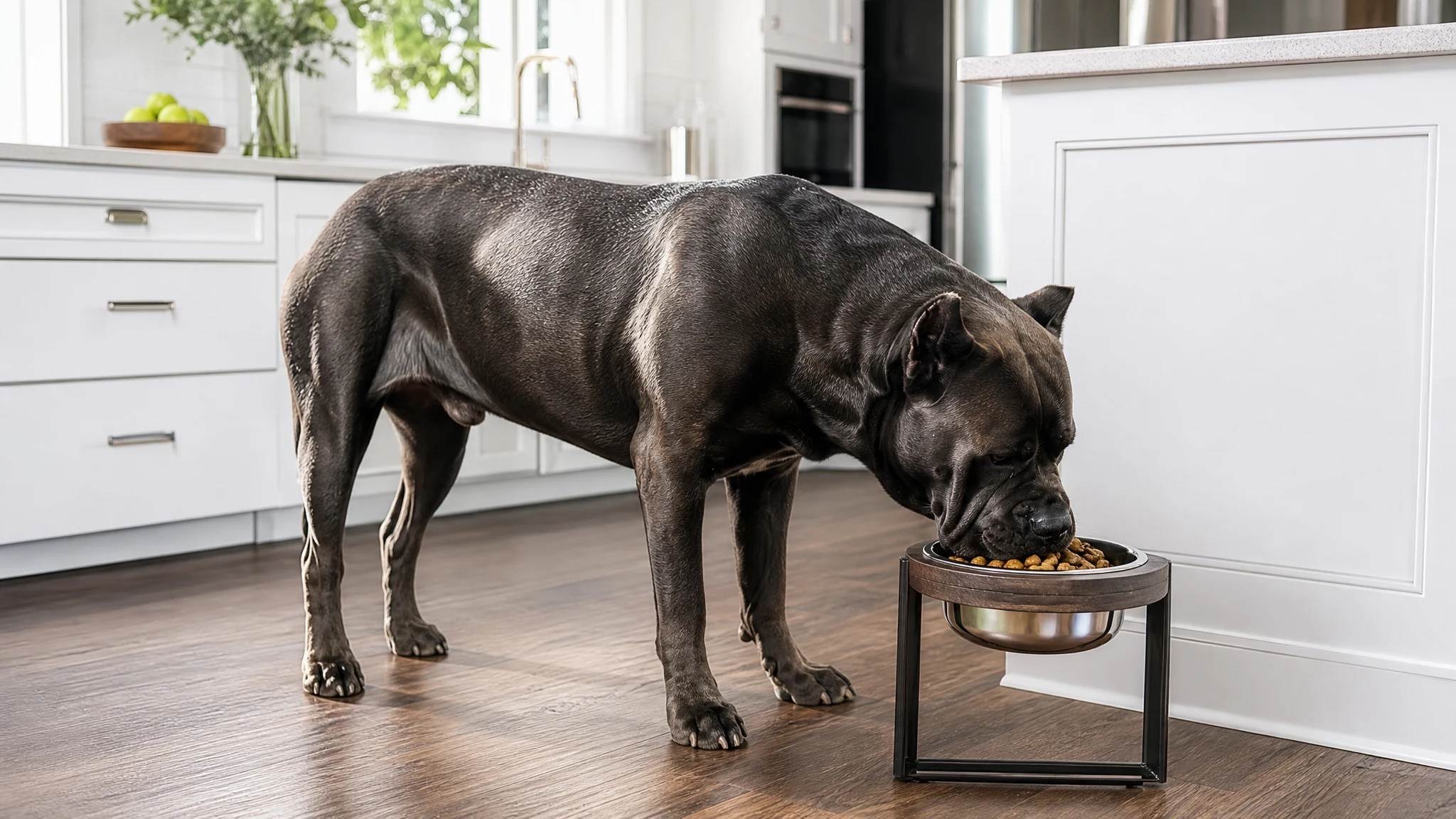
General nutrition information compiled from product labels and published sources, not veterinary advice. Your veterinarian is the right person to choose a diet for your dog, especially one with a health condition.
Adding a spoonful of wet food to kibble is a common way to make meals more appealing. For a Cane Corso, the main risk is not the mixing itself. It is the extra calories, the wrong life stage formula, and food left out too long.
This guide walks through a simple method for a Cane Corso. It uses label data from the brands' own product pages. We compared label data only. We did not run feeding trials or taste tests, and nothing here is a verdict on how any food performs.
Why Size Matters for a Cane Corso
The Chewy breed education page lists an adult Cane Corso at 88 to 110 pounds. That is above the 70 pound line AAFCO uses for large-size dogs. The same page lists a life expectancy of 9 to 12 years.
Chewy also lists bloat (GDV) and obesity among the health concerns tied to this breed. It says extra weight strains the joints. The Cane Corso Association of America's CHIC page lists hip dysplasia, elbow dysplasia and cardiac evaluation. None of these can be fixed by a food topper. They are reasons to measure meals instead of guessing.
Materials You Need
- Your dog's current dry food, with the bag handy for its calorie statement and feeding guide.
- A wet food that matches your dog's life stage. Check the nutritional adequacy statement on the label.
- A standard measuring cup. The brands' per-cup calorie figures assume one.
- A kitchen scale, if you want to weigh portions.
- A notebook or phone note to track amounts and your dog's weight.
- An airtight container and fridge space for opened cans.
Step 1: Check the Life Stage on Both Foods
Start with the label. A food should say it is complete and balanced for your dog's stage of life, based on the AAFCO statement.
For an adult, look for wording such as "formulated to meet the nutritional levels established by the AAFCO Dog Food Nutrient Profiles for maintenance." Royal Canin's Large Adult page uses this kind of wording.
For a puppy, the details matter more. Whole Dog Journal explains that growth and all-life-stages foods must state whether they include or exclude growth of large-size dogs (70 pounds or more as an adult). Foods labeled "including" are considered appropriate for large-breed puppies. Foods labeled "except for" are not. The same source warns that too much calcium can harm large-breed puppies.
Two examples from the brands' own pages:
- The Hill's Science Diet Adult Chicken & Barley Entree canned food is an all-size adult formula. Hill's does not present it as a large breed formula, and it is an adult maintenance food, not a growth food.
- Freshpet's Complete Nutrition Chicken Recipe is also an adult maintenance food. Freshpet's page does not make it a growth formula, so it is not a match for a Cane Corso puppy.
If your puppy eats a large breed growth kibble, topping it with an adult-only wet food changes the overall balance. Ask your veterinarian before you do that.
Step 2: Find the Calories in Each Food
Calories are the part most owners skip. Here are label figures from the brands' own pages:
| Food | Form | Calories on the label |
|---|---|---|
| Hill's Science Diet Adult Large Breed (Chicken & Barley) | Dry | 365 kcal per cup |
| Hill's Science Diet Puppy Large Breed | Dry | 387 kcal per cup |
| Royal Canin Large Adult | Dry | 360 kcal ME per cup (as fed, calculated) |
| Victor Elite Canine | Dry | 386 kcal per cup |
| Hill's Science Diet Adult Chicken & Barley Entree | Wet (13 oz can) | 369 kcal per can |
| Freshpet Complete Nutrition Chicken Recipe | Fresh roll | 1,357 kcal/kg (calculated); no per-cup figure published |
Notice that one 13 oz can of the Hill's wet food has about as many calories as one cup of the Hill's adult large breed kibble. That is a helpful comparison. A scoop of wet food is not "free." It adds to the day's total.
Other foods list calories in different units. Convert them with care, or check the brand's page.
Step 3: Start From the Label's Feeding Guide
Use the dry food's feeding guide as your starting point. Brands set amounts by weight, age or activity level, and each guide is a starting point only.
Examples from the brands' pages:
- Royal Canin lists Large Adult amounts in cups and grams by target adult weight and activity level. A 62 pound dog with low activity is listed at 3 cups (290 g) per day. That is an example from the label, not a Cane Corso figure.
- Victor charts adult amounts by weight. For dogs over 100 pounds, the page says to add 1/2 cup for every 20 pounds above 100.
- Hill's tells owners to adjust amounts as necessary to maintain optimal weight, and to ask a veterinarian if unsure.
For age-based planning, see our Cane Corso feeding chart by age.
Step 4: Swap, Do Not Stack
This is the step that keeps portions honest. Instead of adding wet food on top of a full bowl, replace some of the kibble.
- Work out the dry food calories your dog gets per day from the guide.
- Decide how much of that you want to come from wet food. A small share is a common starting point.
- Find the wet food's calories per can or per serving.
- Remove the matching calories from the dry portion.
- Mix the two and serve.
As a worked example with the Hill's figures above, a quarter of a can is about 92 kcal. A quarter of a cup of the Hill's adult large breed kibble is about 91 kcal. So swapping a quarter can of wet for a quarter cup of dry keeps the day's total close to the same.
This is arithmetic from label numbers, not a prescription. Your dog's real needs depend on weight, age and activity, so confirm with your veterinarian.
Step 5: Introduce the Mix Gradually
A sudden change can upset a dog's stomach. Add a small amount of wet food at first. Watch stool and appetite for several days before you raise the amount.
If you see vomiting, ongoing loose stool or refusal to eat, stop the change and call your veterinarian.
Step 6: Serve and Store Safely
- Measure into the bowl. Do not eyeball the wet portion.
- Follow the brand's storage directions. Freshpet says to keep its roll refrigerated and use it within 7 days of opening. For canned food, check the can and the Hill's page, or contact the brand, for opened-can guidance.
- Do not leave mixed food out for long periods. Wet food and dry food behave differently once combined. Check the brand for its advice on how long it can sit out.
- Wash the bowl. Do this between meals, especially when wet food is in the mix.
Because Chewy lists bloat as a concern for this deep-chested breed, ask your veterinarian about meal size, meal timing and activity around meals. A gastropexy is a surgery Chewy mentions in connection with bloat. Whether it makes sense for your dog is a question for your vet.
Common Mistakes to Avoid
- Adding wet food on top of a full ration. This is the quickest way to add weight, and the breed page flags obesity as a joint concern.
- Using an adult wet food with a puppy. Puppies need food labeled for growth, including large-size dogs.
- Trusting the front of the bag. Marketing terms like "premium" are not nutrition data. Read the adequacy statement, ingredients and calories.
- Assuming wet food and kibble match by volume. A cup of one is not a cup of the other. Compare calories.
- Using the can's feeding table as-is. Hill's lists a 50 pound dog at 3 1/4 cans per day of its wet food as a sole diet. That table is for the wet food alone and for a smaller dog. It does not apply to a Cane Corso or to a mix.
- Changing foods to treat a health issue. A food does not prevent or cure hip dysplasia, heart disease or bloat. A veterinarian decides diet for an individual dog.
- Using a prescription diet without a prescription. Those are only something a veterinarian prescribes.
Tips That Make It Easier
- Keep the same wet flavor for a few weeks so you can spot what bothers your dog.
- Weigh your dog on a regular schedule and note it with your feeding record.
- Check the ingredient list for both foods. The Hill's wet food lists water first, which is normal for canned food and is why its dry matter numbers look different from its label numbers.
- Use the dry matter figures on a page only to compare foods, not as minimums. The Hill's pages call these averages, not minimums.
- Ask the brand directly if a detail is missing. Kibble size, for example, is not listed on the pages we reviewed for several of these foods.
Expected Results
If you match calories and change foods slowly, many owners find that mealtime goes smoothly and that their dog's weight stays steady. Results vary from dog to dog, and no feeding method is a guarantee.
Check your dog's body condition and weight regularly. If your dog gains weight, trim the portions. If your dog has a health condition, is a puppy, or is a senior, confirm amounts with your veterinarian before you start mixing.
A Note on Heart Health and Grain-Free Diets
The FDA's page on its investigation into diets and canine dilated cardiomyopathy (DCM) was last updated December 23, 2022. The FDA said it did not plan further public updates until there is meaningful new scientific information. Check the FDA page for anything newer. The Cane Corso Association of America's CHIC page lists a cardiac evaluation. If your dog has any heart concern, your veterinarian should guide the diet.
Sources
- Chewy breed education page: Cane Corso
- Cane Corso Association of America: AKC Canine Health Foundation and CHIC
- Whole Dog Journal: In the Fine Print, Nutritional Adequacy Statements
- FDA Center for Veterinary Medicine: DCM investigation
- Hill's Pet Nutrition: Science Diet Adult Large Breed
- Hill's Pet Nutrition: Science Diet Adult Chicken & Barley Entree
- Royal Canin US: Size Health Nutrition Large Adult
- Victor Super Premium Pet Food: Elite Canine
- Freshpet: Complete Nutrition Chicken Recipe