When to Switch a Cane Corso Puppy to Adult Food
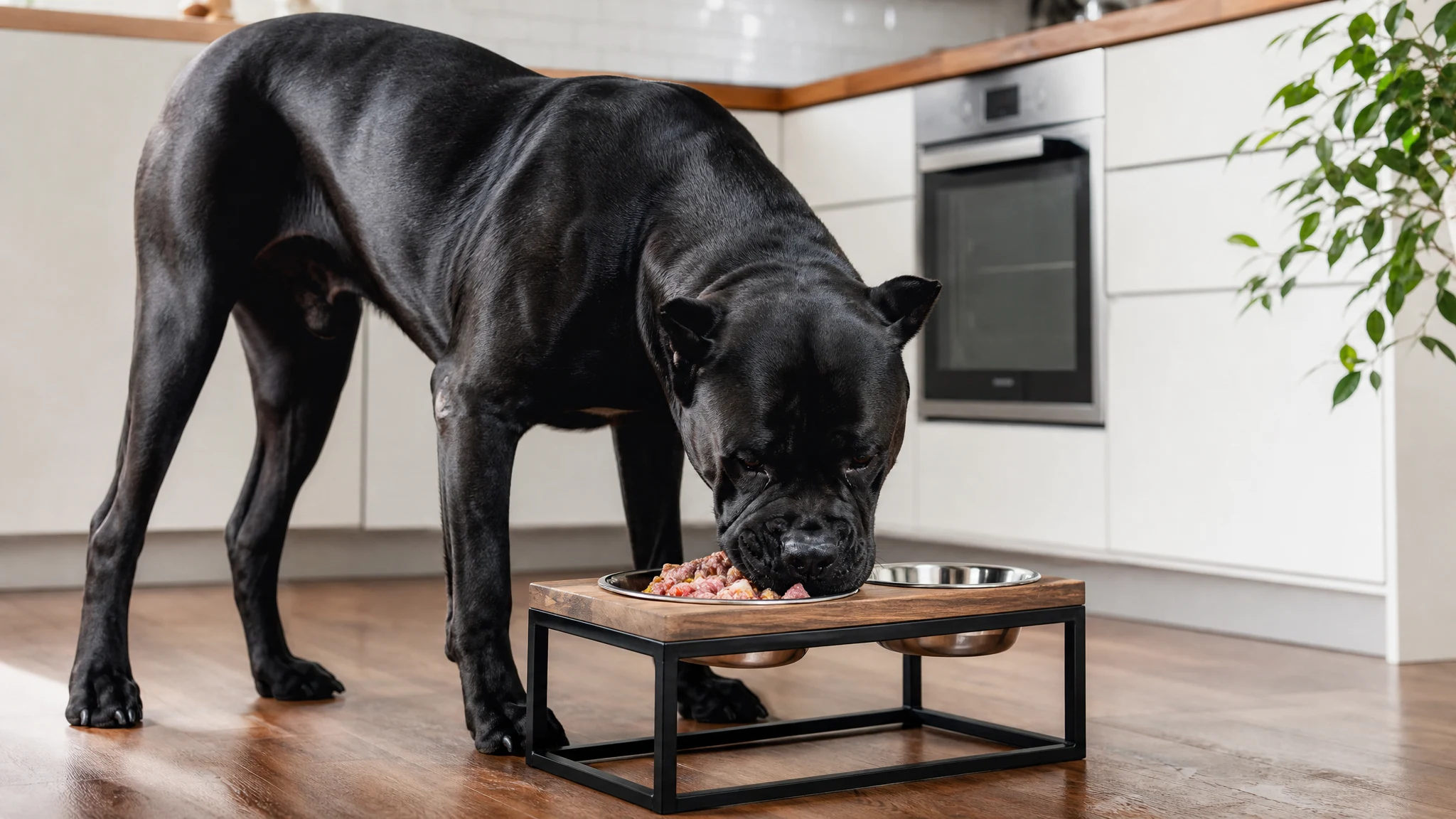
General nutrition information compiled from product labels and published sources, not veterinary advice. Your veterinarian is the right person to choose a diet for your dog, especially one with a health condition.
Most owners ask this when the puppy starts to look like a grown dog. A Cane Corso is a large breed, and Chewy's breed education page lists adult weight at 88 to 110 pounds. That size changes how you think about the switch.
No source we checked gives a single age at which a Cane Corso counts as an adult. So this guide shows you how to decide with your veterinarian, read the label, and make the change slowly.
Why the timing is not one number
Brands set their own life stage windows, and they differ. On its product page, Royal Canin lists its Size Health Nutrition Large Puppy for large breed puppies up to 15 months. Its Large Adult formula is listed for dogs from 15 months to 5 years.
Hill's Pet Nutrition lists its Science Diet Puppy Large Breed formula for large breed puppies up to 18 months. Its Adult Large Breed formula is listed for large breed adults aged 1 to 5 years.
Those windows overlap and disagree. They are label categories, not a Cane Corso growth chart. Ask your veterinarian when your own dog should move, and check with the Cane Corso Association of America if you want the breed club's view.
Materials you need
- The puppy food your dog eats now, with the bag or can label.
- The adult food you plan to use, with its label and its brand feeding chart.
- A standard measuring cup or a kitchen scale.
- A notebook or phone note for meals, stool quality and weight.
- Your veterinarian's contact details, for a weight check before and after.
Step 1: Ask your veterinarian if your puppy is ready
Book a weight and body condition check. Ask whether your puppy has reached the stage where an adult formula makes sense. Ask whether growth is on track and whether the vet wants the switch earlier or later.
If your dog has a health condition, ask your vet to confirm the food and the amounts before you change anything. A veterinarian decides for an individual dog. Prescription diets come only from a veterinarian.
Step 2: Read what your current puppy food says
Check the nutritional adequacy statement. According to Whole Dog Journal, growth and all life stages foods must state whether they include or exclude growth of large size dogs, meaning 70 pounds or more as an adult. Foods labeled "including" are considered appropriate for large breed puppies. Foods labeled "except for" are not.
Whole Dog Journal also notes that too much calcium can harm large breed puppies. That is why a large breed puppy should stay on a growth food labeled for large dogs until the switch.
Some foods are labeled for all life stages. Victor's Hi-Pro Plus Large Breed Puppy, for example, states it meets AAFCO nutrient levels for all life stages, including growth of large size dogs. Check any label against the brand's own page.
Step 3: Choose an adult food by its label
We compared label data from brand pages. We did not run feeding trials or taste tests, so none of this is a ranking.
Look for these things:
- A large breed adult formula, or a statement that it fits dogs of your Cane Corso's size.
- An AAFCO statement for adult maintenance or all life stages.
- The first ingredients, and calories per cup.
Here are examples from the brands' own pages. They are not recommendations.
| Food (brand page) | Label life stage | Calories per cup |
|---|---|---|
| Hill's Science Diet Adult Large Breed Chicken & Barley | Large breed adult, 1 to 5 years | 365 kcal |
| Royal Canin Size Health Nutrition Large Adult | Adult, 15 months to 5 years | 360 kcal ME |
| Victor Elite Canine | All life stages, large breed | 386 kcal |
Protein and fat figures are not directly comparable across these pages. Royal Canin and Victor list minimums. Hill's lists dry matter averages for its foods. Read them with that in mind.
Not every food in a store suits a Cane Corso. Freshpet's Complete Nutrition Chicken Recipe is labeled for adult maintenance only, so it is not a growth food for a puppy. Hill's Adult Chicken & Barley canned entree is an all-size adult formula, not a large breed one. For a longer look at what matters in a Cane Corso diet, see our guide to Cane Corso nutrition and the diet factors that matter.
Step 4: Work out the starting amount
Use the brand's own feeding chart as a starting point. Charts go by target adult weight and activity level. Royal Canin's Large Adult page, for instance, lists amounts in cups and grams per day by weight and activity, and gives 3 cups (290 g) per day for a 62 pound dog with low activity. That example is lighter than a typical adult Cane Corso, so find your dog's own row instead.
Victor's Elite Canine page says that for dogs over 100 pounds you add 1/2 cup for every 20 pounds above 100. Hill's pages say to adjust amounts as necessary to maintain optimal weight and to ask your veterinarian if you are unsure.
Calories per cup differ between a puppy food and an adult food. Hill's Puppy Large Breed lists 387 kcal per cup, while its Adult Large Breed lists 365. Royal Canin Large Puppy lists 349 kcal ME per cup, while its Large Adult lists 360. A cup of one food is not a cup of the other, so measure rather than guess.
Step 5: Transition slowly
A gradual change is a common approach, and your veterinarian or the brand's directions may suggest a different pace. A simple plan runs over about a week to ten days:
- Days 1 to 3: mostly puppy food with a small share of adult food.
- Days 4 to 6: about half and half.
- Days 7 to 9: mostly adult food with a small share of puppy food.
- Day 10 onward: adult food only, if stools and appetite look normal.
Keep the total amount at the calculated starting point, not more. Split meals as your vet advises. Avoid a single large meal for this breed. Chewy's breed education page lists bloat, a risk tied to the deep chest, among Cane Corso health concerns, so ask your vet about meal size and timing.
Step 6: Watch and adjust
For the first few weeks, note stool quality, appetite, energy and body shape. Run your hands along the ribs. You should be able to feel them without pressing hard. Chewy's breed page lists obesity as a concern because extra weight strains the joints.
The Cane Corso Association of America's CHIC page lists hip dysplasia, elbow dysplasia and cardiac evaluation among the breed's health screening items. Food alone does not prevent or treat these. A veterinarian can talk through diet, weight and your dog's records.
Tips
- Weigh your dog at the same time each month and bring the numbers to the vet.
- Change only one thing at a time. Do not add new treats during the switch.
- Keep the old food bag until the transition ends, in case you need to slow down.
- Re-check amounts if activity changes.
Common mistakes
- Switching by age alone. Brand windows vary, and your dog's growth and condition matter.
- Switching all at once. A sudden change can upset the stomach.
- Assuming a cup is a cup. Calories per cup differ between foods.
- Choosing an all-size adult food by default. Check whether the label fits a large dog.
- Adding supplements on your own. Talk to your vet first. We give no supplement amounts here.
What to expect
With a gradual change, many dogs settle onto the new food within a couple of weeks. You may see steady stools, a normal appetite and a stable weight. Results vary by dog, and a softer stool or a picky spell can happen.
If you see vomiting, diarrhea that lasts, a swollen belly, weight gain or loss that worries you, or a dog that stops eating, contact your veterinarian. Bloat symptoms are an emergency.
On the FDA's page about diets and dilated cardiomyopathy (DCM), which was last updated December 23, 2022, the agency said it did not plan further public updates until there is meaningful new scientific information. Ask your vet about heart health and diet rather than relying on label trends.
Sources
- Whole Dog Journal, nutritional adequacy statements
- Cane Corso Association of America, CHIC page
- FDA CVM, DCM investigation page
- Hill's Science Diet Puppy Large Breed
- Hill's Science Diet Adult Large Breed
- Royal Canin Large Puppy
- Royal Canin Large Adult
- Victor Hi-Pro Plus Large Breed Puppy
- Victor Elite Canine
- Freshpet Complete Nutrition Chicken Recipe